New Orleans Grease Trap does grease trap cleaning for kitchens in Meraux: we pump out the trap, scrape the walls and baffles, check the fittings, and hand you the paperwork for the visit. Most kitchens out here run an indoor trap under a sink or beside the fryer line, and that is the job we do most.
Meraux is about 20 to 25 minutes from our base in New Orleans, down Judge Perez Drive. It is a small community, and we will say so plainly: there are not many commercial kitchens here, and many of them sit in the same stretch of St. Bernard Parish as Chalmette next door. We plan visits across that stretch together where schedules allow, so a Meraux kitchen is not treated as an afterthought.
If your trap is slow, smells, or has gone longer than it should between visits, call (504) 360-9231, Monday to Friday, 9:00 AM to 5:30 PM. Tell us the kind of kitchen you run and roughly what size the trap is. If you do not know the size, we will work it out with you.
What Meraux kitchens are like
The kitchens here are mostly small and owner-run: fried seafood and plate-lunch counters, neighborhood cafes, a bar kitchen or two, the occasional catering operation working out of a commercial space. Fryers, dish sinks and floor drains run all day, and a small trap fills faster than most owners expect.
Traps this size, the passive indoor kind, run roughly 40 to 200 gallons. Most local restaurants clean small traps every one to four weeks, and the real answer for your kitchen depends on volume. A seafood kitchen frying all lunch and dinner will fill a trap quicker than a cafe that mostly grills and plates.
That is why interior trap work is the fit here. The trap is small, it sits inside your kitchen, and it needs to be kept up on a regular rhythm. Large exterior interceptors are a different job, and a few kitchens in the area may have one. We handle those as well, and the prices are further down.
The rules your trap runs under
Four rules set the schedule, and we run every trap to them.
- Every 90 days at the outside. A trap gets pumped at least every 90 days, however light the kitchen.
- The 25 percent rule. When the contents reach 25 percent of the trap's design capacity, measured to the outlet invert, it is pumped within two working days.
- Defects get fixed. Anything an inspector finds is corrected within 90 days.
- Records stay on site. Manifests and service records are kept at the kitchen for three years.
Those intervals come from the New Orleans fats, oils and grease program. For what St. Bernard Parish asks of your particular kitchen, confirm with the parish. We service to the intervals above because they are the working standard in the trade here. State rules apply everywhere: grease trap waste moves on a Louisiana DEQ manifest carrying our name, address, phone, vehicle number, LDEQ hauler registration number, the date and the volume. There is no state pumping interval, so enforcement is local.
How a visit runs
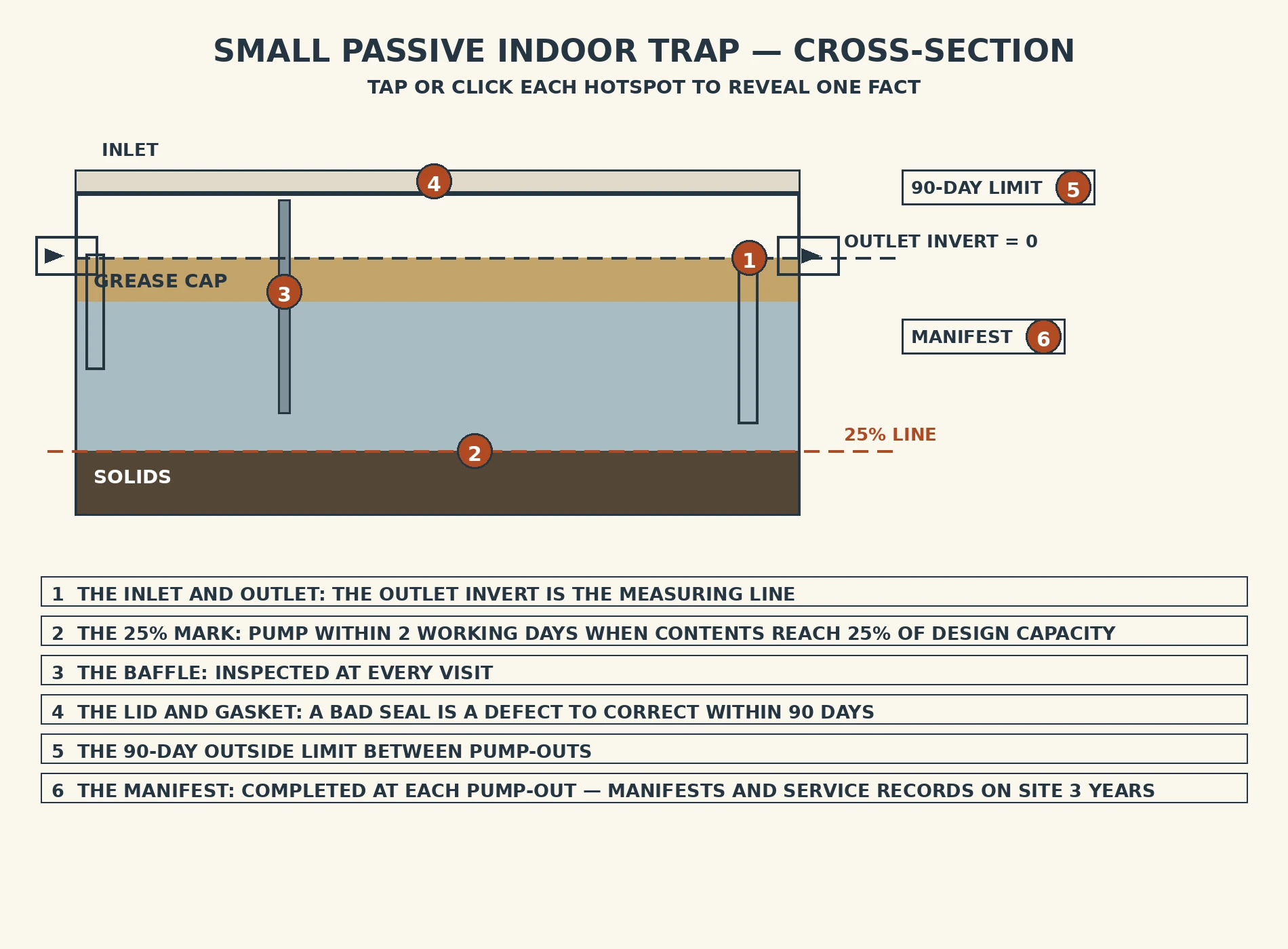
the inlet and outlet, and why the outlet invert is the measuring line
the 25 percent mark, with the rule "pump within two working days when contents reach 25 percent of design capacity"
the baffle, and why we inspect it at every visit
the lid and gasket, and why a bad seal is a defect to correct within 90 days
the 90-day outside limit between pump-outs
the manifest, what is on it, and the three-year on-site records rule.
1. We arrive and open the trap
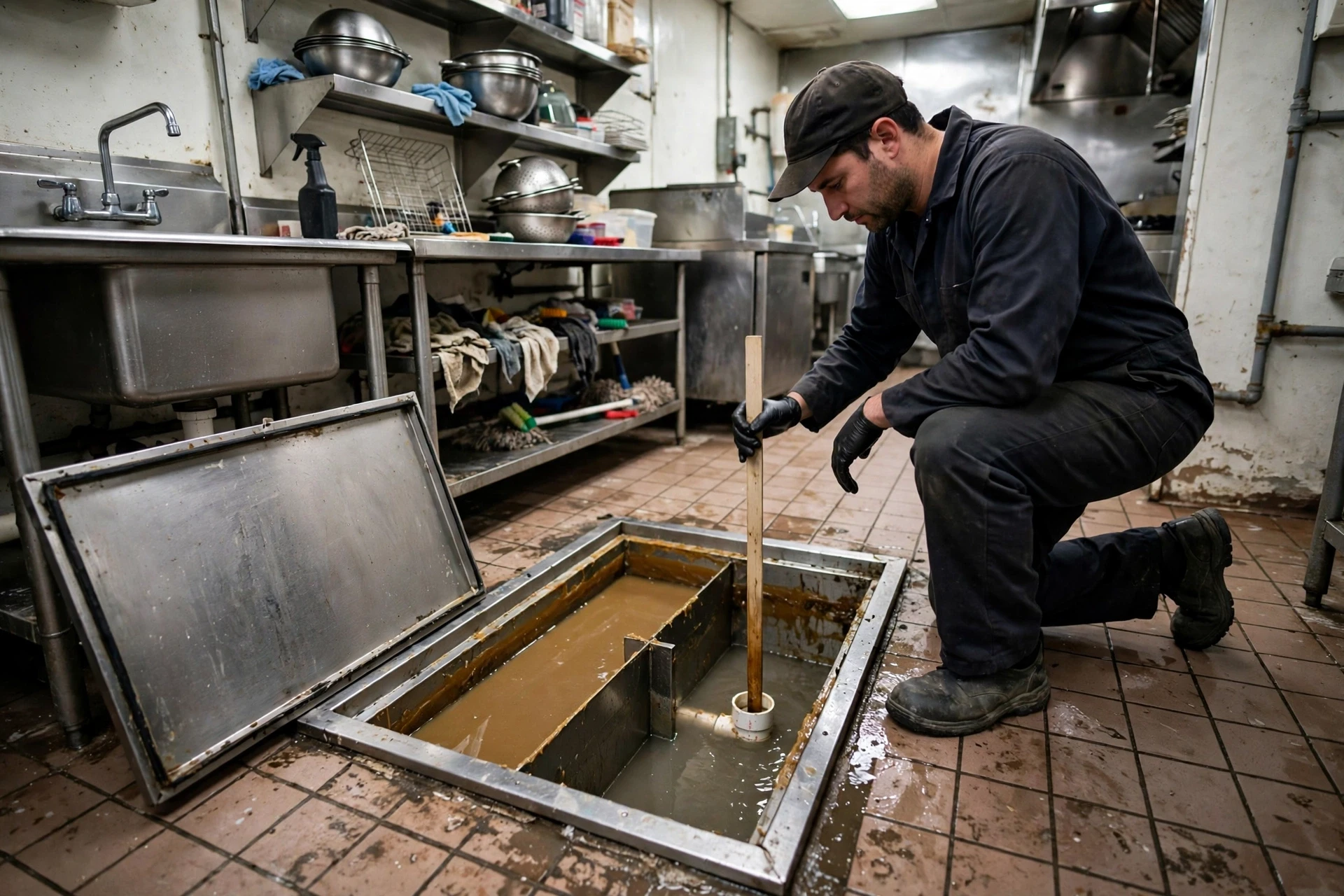
We come during your slow hours when we can, find the trap, and open the lid. Before anything is pumped, we measure the contents against the outlet invert and tell you where it stands against the 25 percent line. That number is what tells you whether your interval is right.
2. We pump out the contents
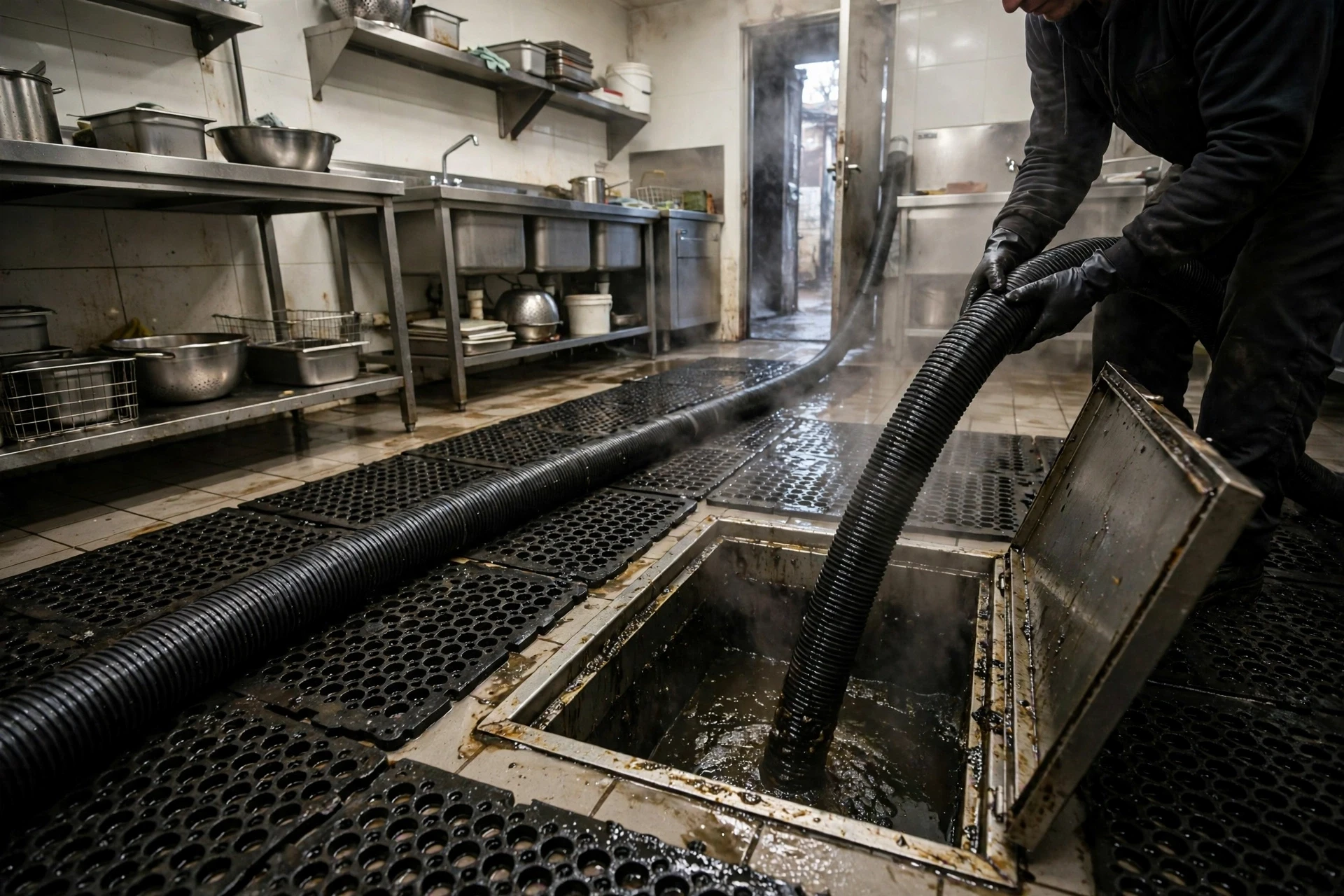
Everything comes out: the floating grease, the water and the solids at the bottom. A trap that is only skimmed leaves the sludge layer behind and fills faster the next time.
3. We scrape, inspect and close up
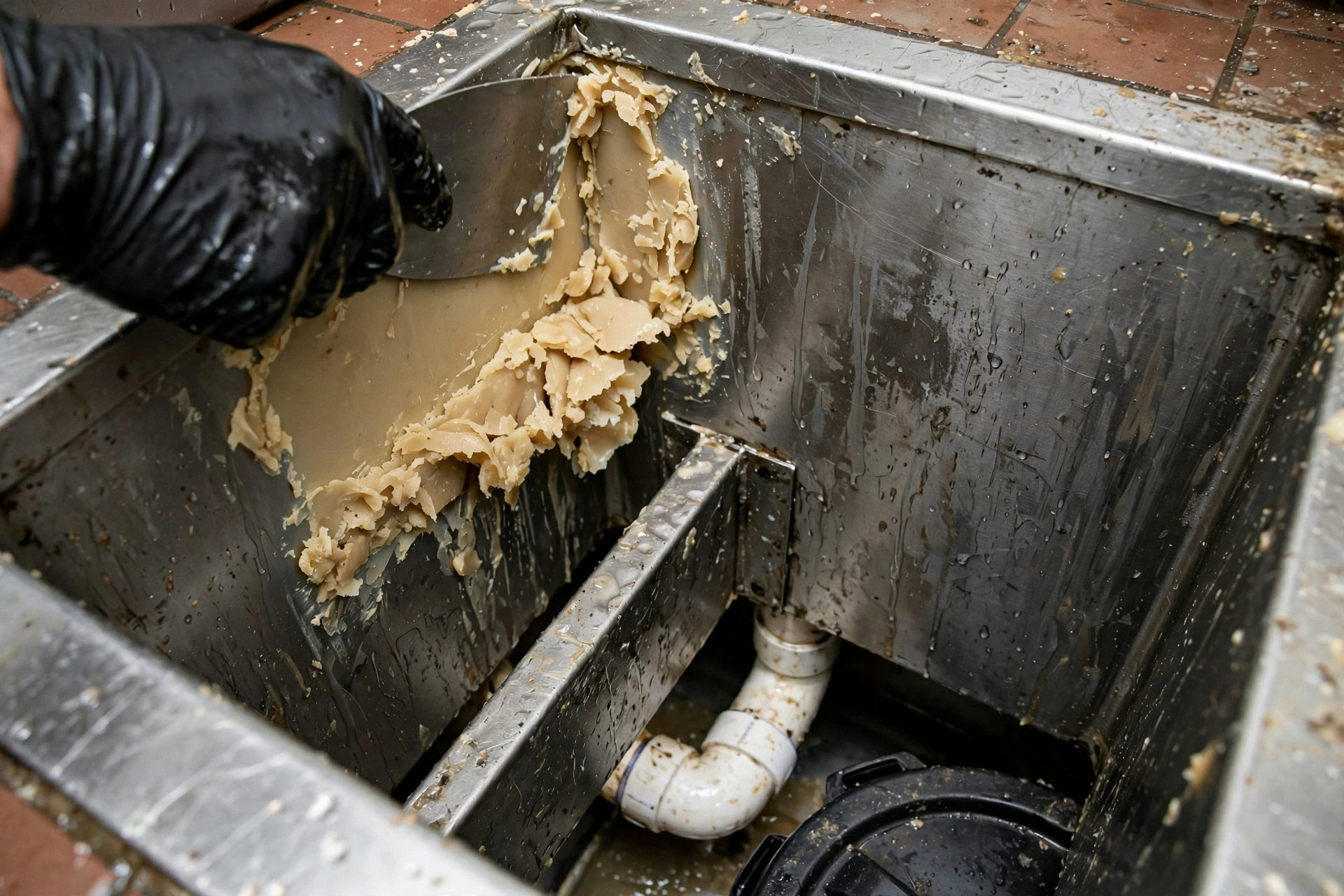
The walls, the baffle, the inlet and outlet fittings and the lid gasket get scraped and checked. A cracked baffle or a lid that no longer seals gets written down and shown to you, because those are the things an inspector looks at.
4. We leave you the paperwork
You get the manifest and a service record for the visit. Keep both on site for three years. If an inspector comes, they are what you hand over.
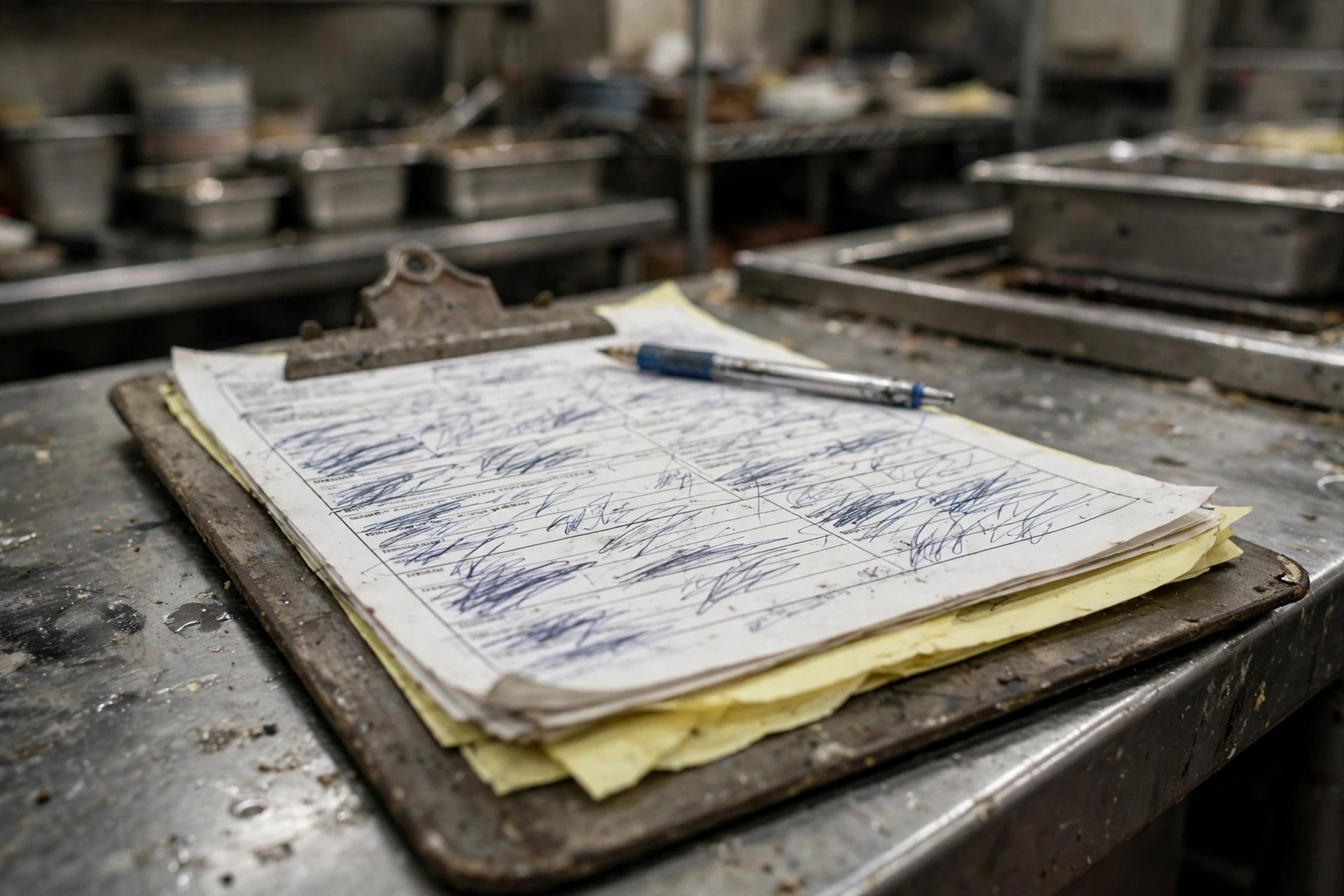
Featured job: a fried seafood counter on Judge Perez Drive
This job is built from a kitchen type Meraux really has: a small fried seafood and plate-lunch counter with one indoor trap, a busy fryer line and a habit of calling for service only when something went wrong.
The situation
The owners cleaned the trap when the kitchen started to smell, which meant long gaps in the quiet months and a rush to catch up after busy ones. The floor drain beside the fryers had begun to back up slowly at the end of a lunch service. The trap was in the up-to-200-gallon band, a passive indoor unit under the prep area. The bigger worry was paperwork, because the kitchen had no manifests on site to show anyone.
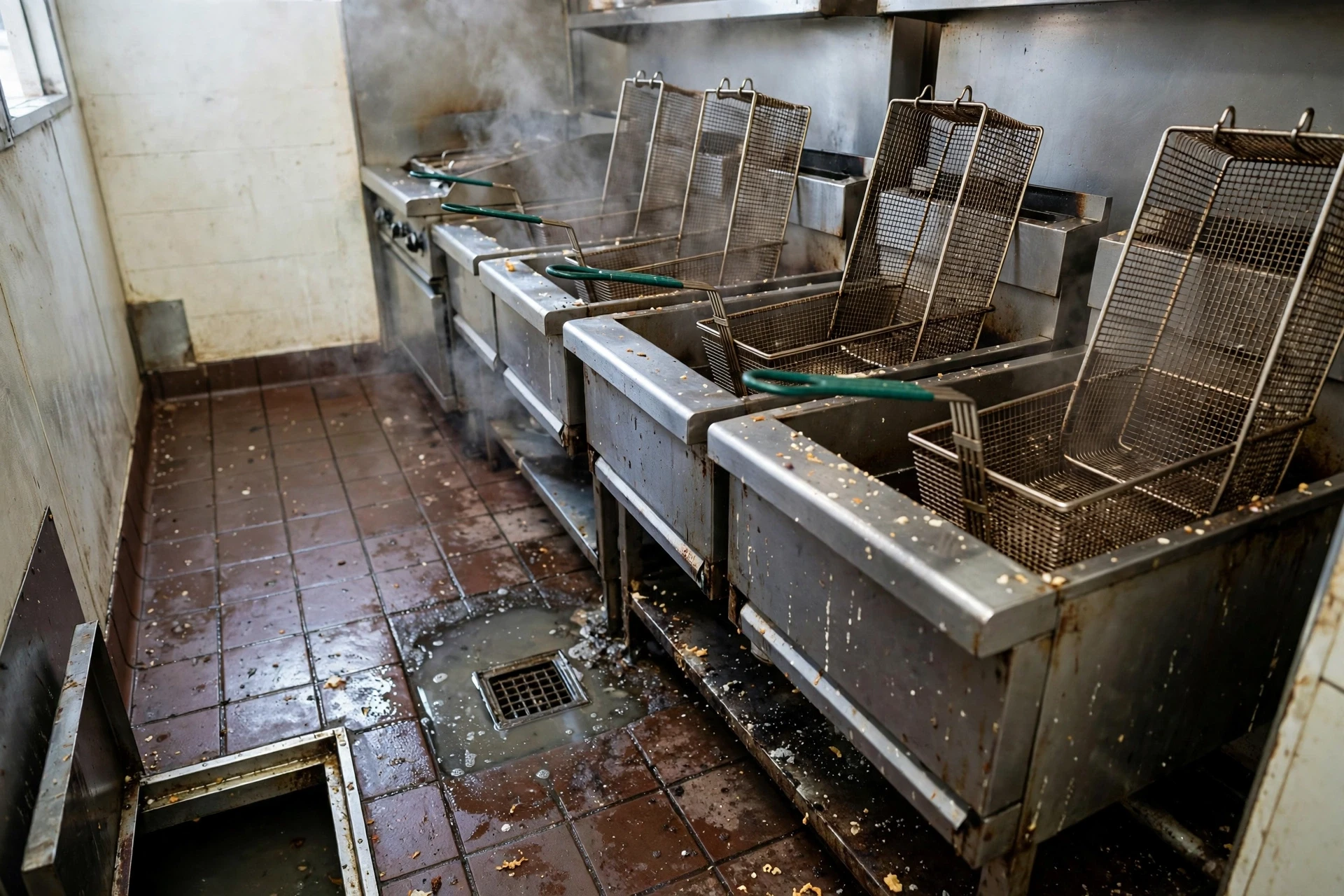
The first visit
We opened the trap and measured. The contents were well past 25 percent, which told the owners the trap was overdue, not that the drain was failing. We pumped it out, scraped it, and checked the baffle and the lid gasket. The slow drain line was still sluggish afterward, so we jetted it. The trap cost $125 to $180 on a scheduled visit for its size, and the jetting added $100 because it was done with the service visit.
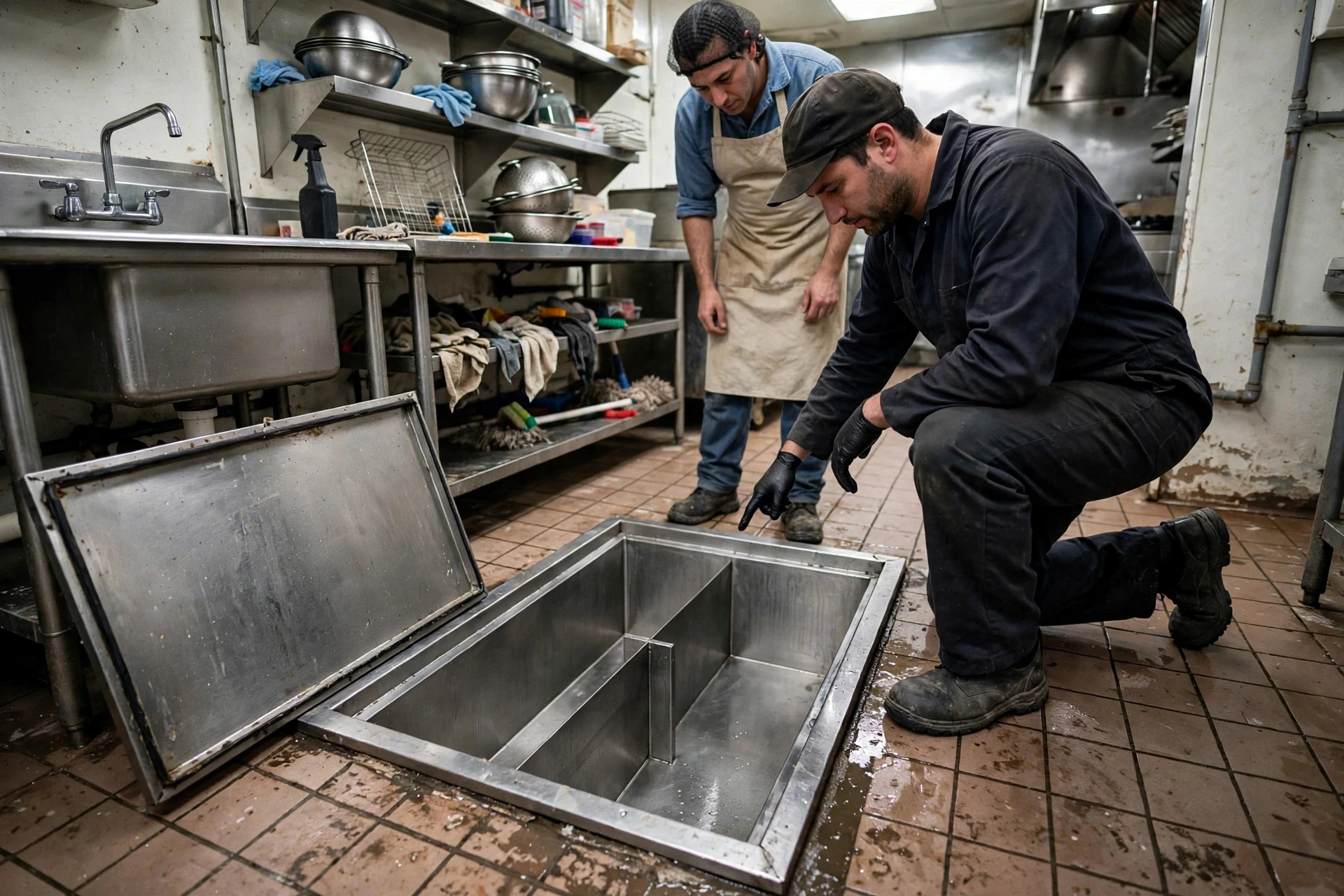
The schedule and the records
Rather than guess, we measured the depth on the next couple of visits and set an interval from what the fryer line actually produced, inside the trade's usual one to four weeks for small traps and never longer than the 90-day limit. Fryer oil was handled separately. Clean used cooking oil is collected at no charge, in containers from 30 to 320 gallons. Each visit now leaves a manifest and a service record, and the owners keep a folder on site for the three-year requirement.

What it costs
These are our prices, and they stay the same whatever the kitchen.
| What we service | Our price per scheduled visit |
|---|---|
| Indoor trap up to 200 gallons | $125 to $180 on a scheduled visit. |
| Indoor trap 201 to 500 gallons | $175 to $475. |
| Emergency indoor trap service | $190 to $240. |
| Interceptor, 1,000 to 1,500 gallons | $225 to $450. |
| Interceptor, 1,501 to 2,000 gallons | $600 to $1,200. |
| Interceptor, 2,001 to 3,000 gallons | $800 to $2,500. |
| Line jetting | $100 when done with a service visit. Heavy jetting is $300 to $600. |
| Used cooking oil collection | no charge for clean oil, in containers from 30 to 320 gallons. |
Where in the range you land depends on trap size, how full it is when we arrive, and how easy it is to reach. A trap that has gone past 25 percent and been neglected costs more to clear than one kept on schedule, which is one more reason to keep the schedule.
When to call
Call when the trap is near or past the 25 percent line, when a drain slows or backs up, when there is a sour smell near the sink or floor drain, or when an inspector has written you up and the 90 days are running. Call before the 90-day limit rather than at it. For a backed-up trap in the middle of service, call and say it is an emergency. We answer Monday to Friday, 9:00 AM to 5:30 PM.
Talk to us about your Meraux kitchen
Tell us what you cook, how big the trap is if you know, and when it was last cleaned. We will give you a price from the list above and a schedule that fits your kitchen. Call (504) 360-9231.
Send us your details
[FORM: Name (required). Phone (required). Service (optional). Town (optional). Message (optional). Consent checkbox (required): "I agree to be contacted by New Orleans Grease Trap about my request."]
The more details you give, the better we are able to help you.
Questions
Do you really service kitchens in Meraux?
Yes. Meraux is about 20 to 25 minutes from our base in New Orleans. It is a small community with a thin base of kitchens, and we group St. Bernard Parish visits with Chalmette next door where schedules allow.
How often does my trap need cleaning?
Most local restaurants clean small traps every one to four weeks. The rule that governs is the 25 percent depth measure, with a hard outside limit of 90 days between pump-outs. We measure at your visits and set the interval from what your kitchen produces.
What is the 25 percent rule?
When the contents of the trap reach 25 percent of its design capacity, measured to the outlet invert, it is pumped within two working days. It is the trigger that tells you the trap is due, whatever the calendar says.
How much does it cost to clean a small trap?
Our price for an indoor trap up to 200 gallons is $125 to $180 on a scheduled visit. A trap of 201 to 500 gallons runs $175 to $475. Position within the range depends on size, how full it is and access.
What if my trap is backed up right now?
Call (504) 360-9231. Emergency service on an indoor trap is $190 to $240. We answer Monday to Friday, 9:00 AM to 5:30 PM.
Does cleaning include the drain line?
Not unless it is added. Line jetting is $100 when done with a service visit. Heavy jetting for a badly blocked line is $300 to $600.
What paperwork will I get?
A manifest and a service record for every visit. Grease trap waste in Louisiana moves on a Louisiana DEQ manifest with our name, address, phone, vehicle number and LDEQ hauler registration number, the date and the volume. Keep manifests and service records on site for three years.
Do the New Orleans rules apply to a Meraux kitchen?
The 90-day limit, the 25 percent rule, the 90-day period to correct defects and the three-year record keeping come from the New Orleans fats, oils and grease program. Meraux is in St. Bernard Parish, so confirm with the parish what it requires of your kitchen. We service to those intervals because they are the working standard in the trade here. The state manifest rule applies everywhere in Louisiana.
What does an inspector check?
Whether the trap is being pumped on schedule, how full it is against the 25 percent line, the condition of the baffle, fittings and lid, and whether your manifests and service records are on site. We check the same things at every visit.
Do you take used cooking oil?
Yes. Clean used cooking oil is collected at no charge, in containers from 30 to 320 gallons.
Can you handle an interceptor if I have one?
Yes. Interceptors are the large exterior tanks. Pumping runs $225 to $450 for 1,000 to 1,500 gallons, $600 to $1,200 for 1,501 to 2,000 gallons, and $800 to $2,500 for 2,001 to 3,000 gallons.
What if an inspector has already written me up?
Defects found at inspection must be corrected within 90 days. Call us with what the inspector wrote, and we will tell you what the trap needs and when we can do it.