When a trap backs up into your kitchen, you need a crew that comes, pumps and gets you cooking again. New Orleans Grease Trap provides emergency grease trap service for restaurants and commercial kitchens across New Orleans, Louisiana, and the prices for it are set out below so you know the number before you dial. Our phones are answered Monday to Friday, 9:00 AM to 5:30 PM, and we say that plainly because it shapes how you should use us.
If a drain is gurgling, a floor sink is filling, or your line cooks are standing in grey water, call (504) 360-9231 during those hours and tell us what you see. The more details you give, the better we are able to help you. The form at the bottom of this page takes the same details if you would rather write it out.
What counts as an emergency
Three situations call for a rush visit rather than a place on the regular route.
- A backup. Wastewater is coming up through floor drains, prep sinks or the dish pit instead of going down.
- An overflow. An interceptor outside is running over at the lid, or a trap indoors is spilling at the cover.
- A kitchen that cannot run. The health of the line depends on the drains. If you cannot wash, rinse or prep without making a mess, you are closed, whatever the trap looks like.
A trap that is merely overdue is different. Under the City of New Orleans rules enforced through the Sewerage & Water Board FOG program, a trap or interceptor must be pumped at least every 90 days. When the contents reach 25 percent of design capacity, measured to the outlet invert, it must be pumped within two working days. A trap sitting at 25 percent is due, and it can be booked on a scheduled visit at the lower scheduled price. A trap at 90 percent and pushing back into the kitchen is an emergency.
What the crew does first
The first minutes on site decide how long you are down.
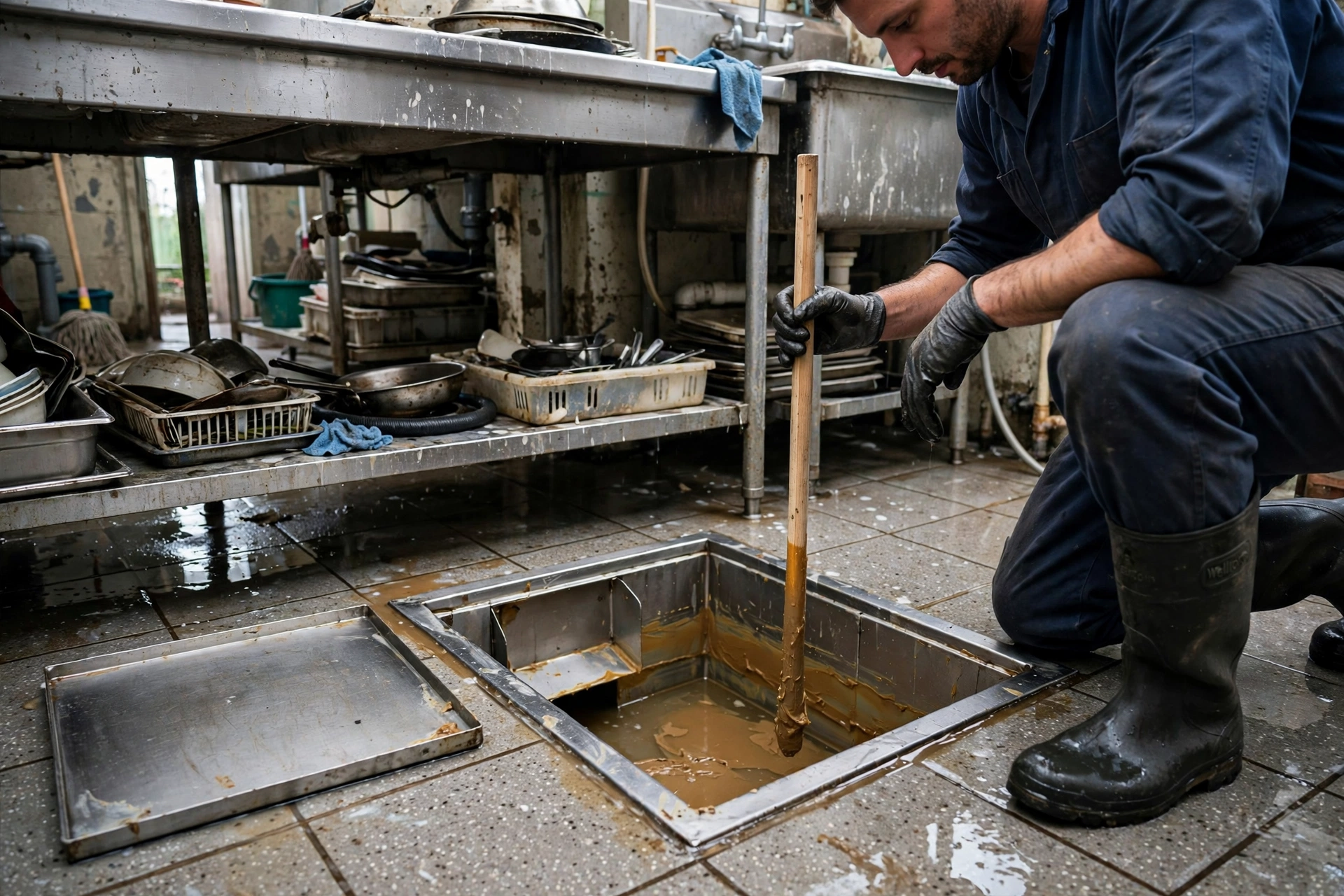
Step 1: Find where the blockage actually is. We ask which fixtures are slow or backing up, then open the trap or interceptor and read the depth. A full trap is the usual cause. Sometimes the trap is fine and the stoppage is in the line past it, and we tell you that before we charge for a pump-out you do not need.
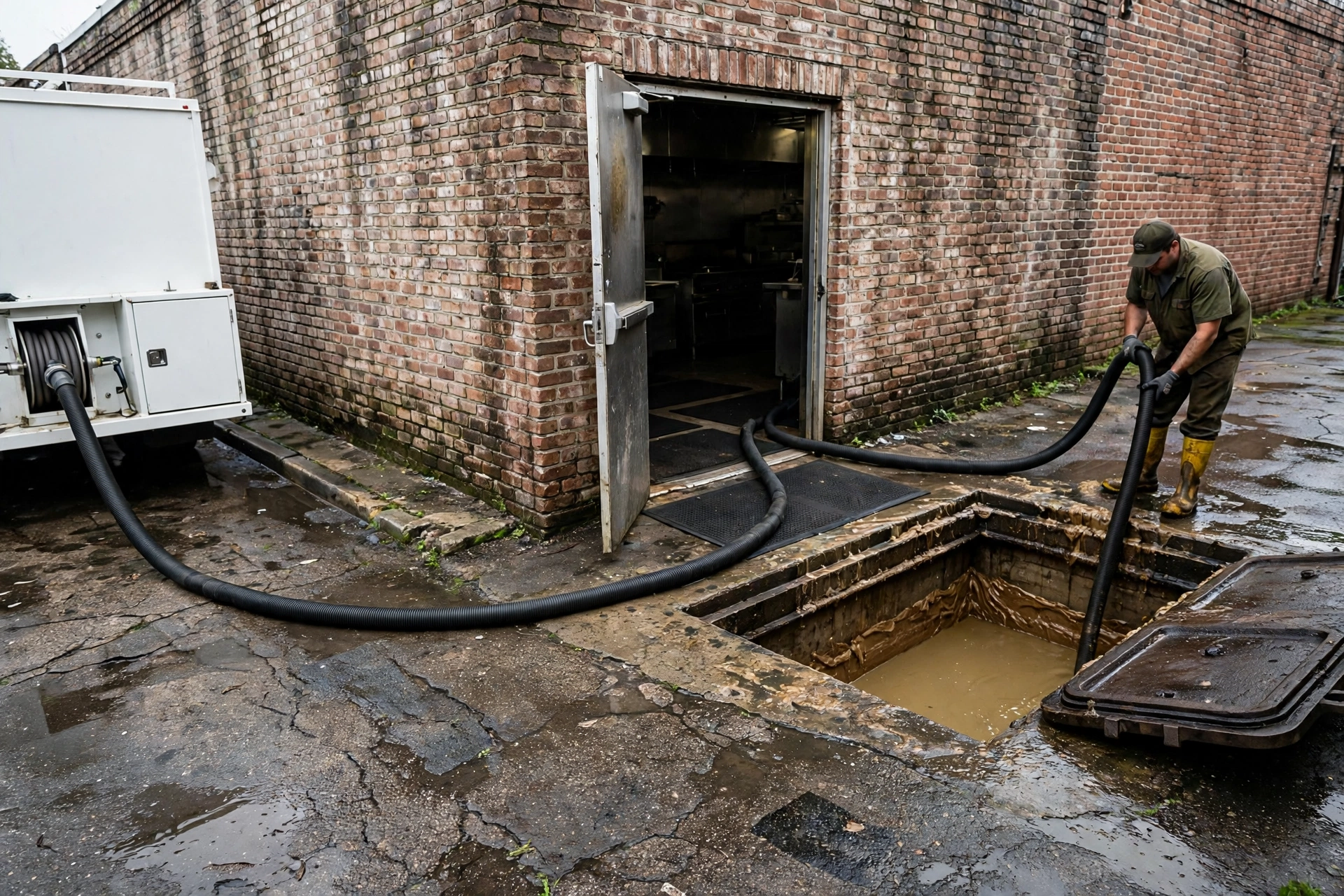
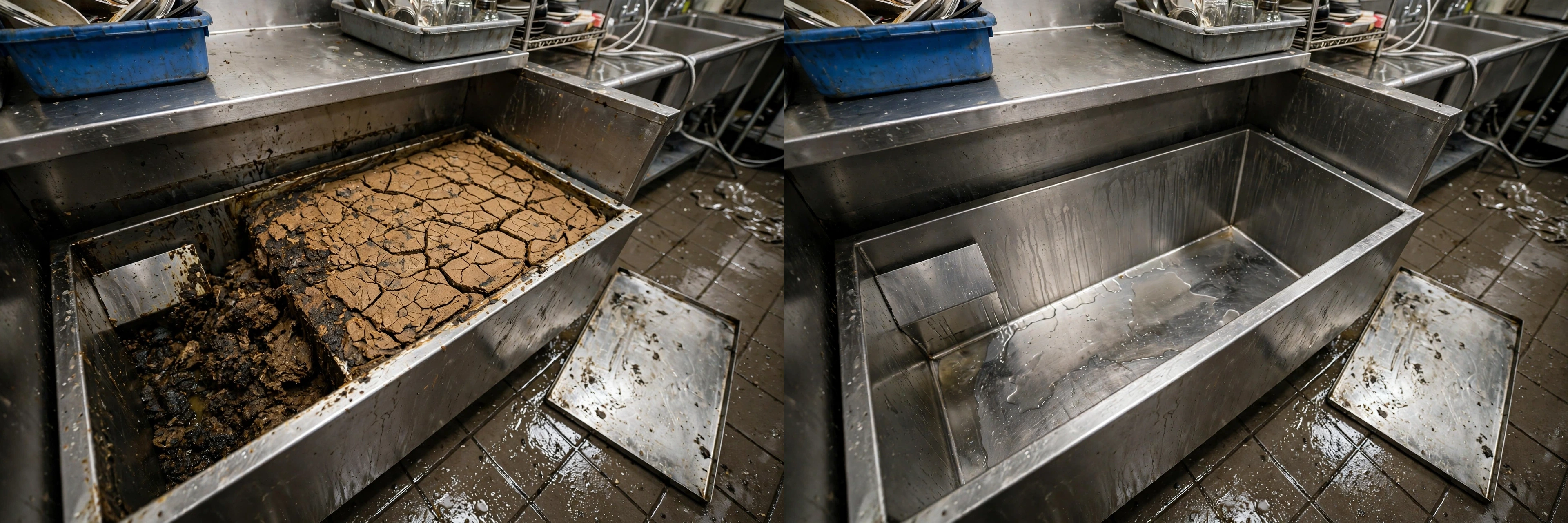
Step 2: Pump and clean it out. We pump the whole contents, scrape the walls, baffles and lid seat, and clear the inlet and outlet pipes. Indoor traps are bailed, scraped and vacuumed. Exterior interceptors are pumped from the truck.

Step 3: Put the lid back, run the water and write it up. We reseat the cover, run water through the fixtures to confirm the drains are moving, and complete the LDEQ manifest with the hauler name, address, phone, vehicle number, registration number, date and volume. You get your copy for the file the inspector will ask for.
How an emergency visit ends
The visit usually does not end at the lid. We tell you what we found: how fast the trap filled, whether the old interval was too long, and whether a worn baffle or a clogged line contributed. Most small-trap kitchens in the city clean every one to four weeks, and a trap that backed up has usually outrun its schedule.
So we leave you with a proposed round: a service interval based on the depth we measured and your volume, written down. That moves you onto a scheduled visit at the scheduled price, with records kept, and keeps the next backup from landing on a Friday.
If the measurements show a larger issue, such as a trap that is too small for the kitchen or a defect, we say so. Under the city's rules defects found at inspection are to be corrected within 90 days, and it is better to fix them on your timeline than on an inspector's.
What it costs
Our emergency prices are listed here so you can decide before you call.
| Emergency job | Our price |
|---|---|
| Indoor grease trap | $190 to $240 |
| Interceptor, 1,000 to 1,500 gallons | $400 to $900 |
Where the price falls in the range depends on how full the unit is, how far the truck hose has to run, and how hard the contents have set. Line jetting is $100 when done with a service visit, and heavy jetting runs $300 to $600 if the line past the trap is the problem.
We do not post emergency prices for traps of 201 to 500 gallons or for interceptors over 1,500 gallons. Those jobs are priced once the crew sees the unit. Our scheduled prices for those sizes are $175 to $475 for traps of 201 to 500 gallons, and $600 to $1,200 for interceptors of 1,501 to 2,000 gallons and $800 to $2,500 for 2,001 to 3,000 gallons.
Scheduled service is cheaper. An indoor trap up to 200 gallons runs $125 to $180 on a scheduled visit, and an interceptor of 1,000 to 1,500 gallons runs $225 to $450. The difference is the reason to get on a round.
Call us
Phones are answered Monday to Friday, 9:00 AM to 5:30 PM. If a backup starts on a Friday evening or over a weekend, we are not answering, and we will not claim otherwise. Leave a message or send the form, and we will respond when the office opens on Monday. If it is Friday afternoon and your drains are going slow, call before 5:30 PM. A trap that is slowing down is easier to catch before it stops.
Call (504) 360-9231 or send the form below.
Featured job: a Friday backup at a seafood house on Magazine Street
A mid-sized seafood house on Magazine Street fries, boils and rinses a great deal, and its 1,250-gallon exterior interceptor had been on a long, informal interval. On a Friday afternoon, with the dinner service to prepare, the dish pit began draining slowly, then not at all.
The call, 3:40 PM
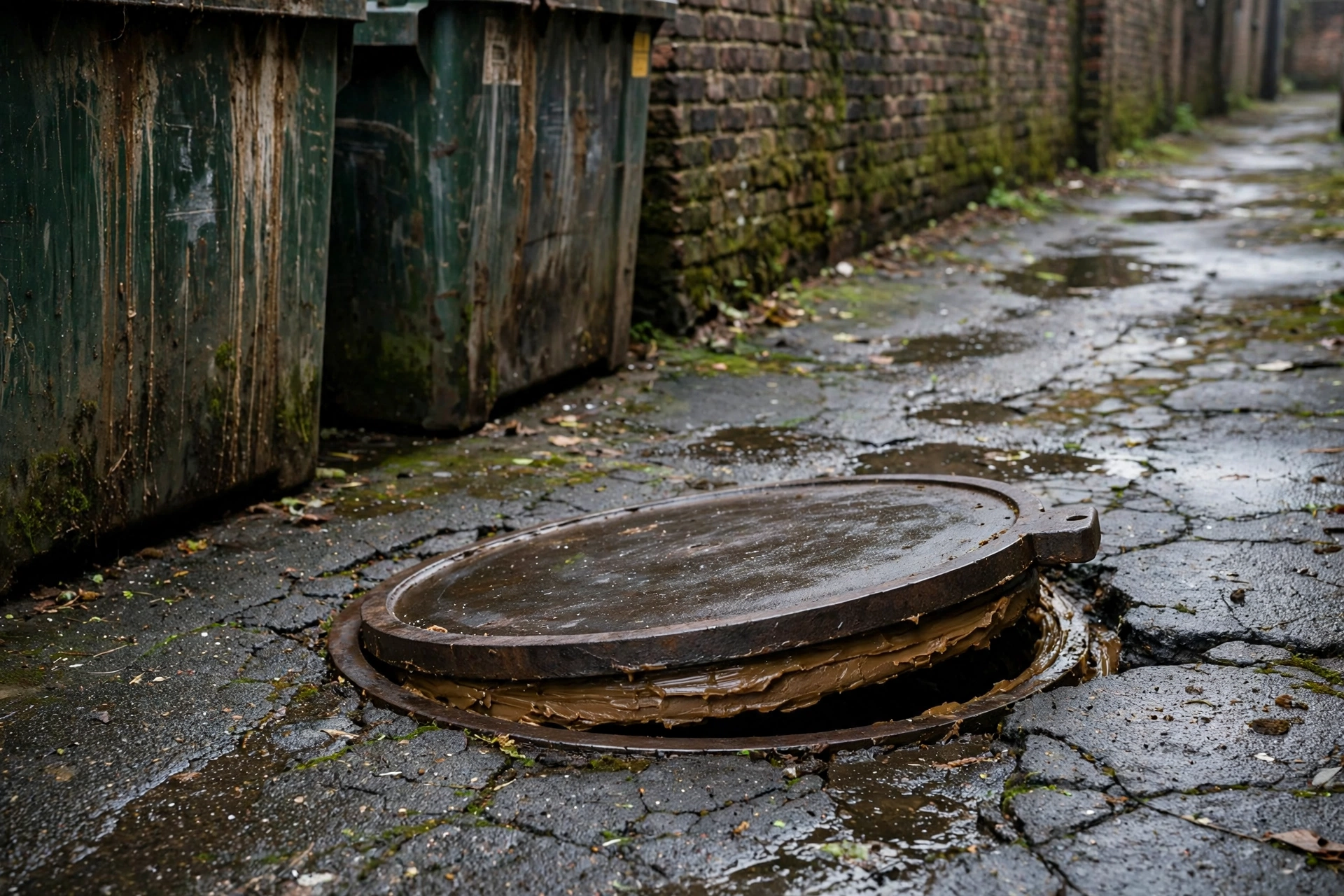
The kitchen manager called within office hours. She described the dish pit, a floor drain bubbling near the walk-in, and a smell from the lid outside. We asked her to keep the lid closed, keep water use to a minimum and tell us when the last pump-out was. Nobody could say.
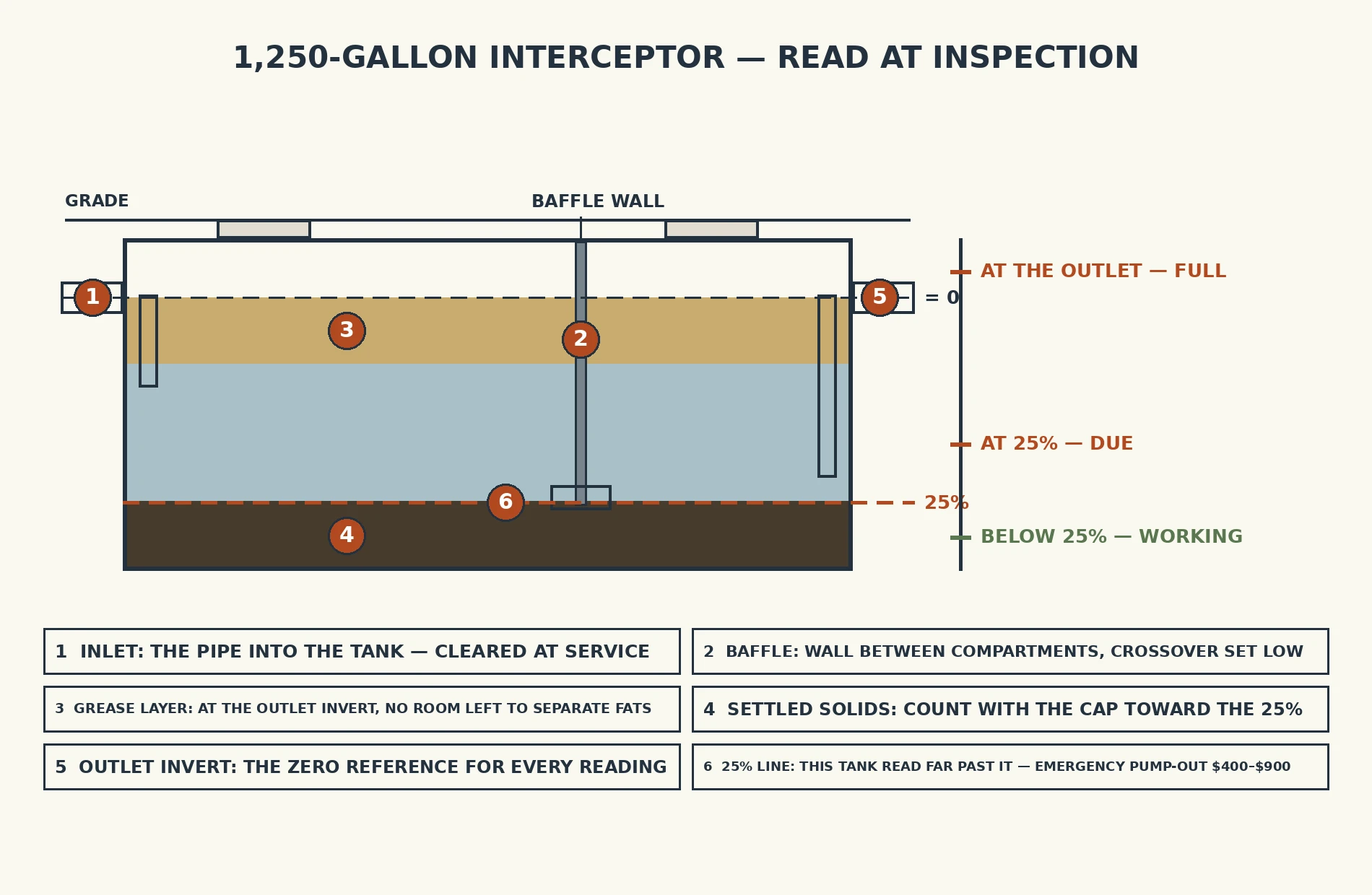
Inlet.
Baffle.
Grease layer.
Settled solids.
Outlet invert.
The 25 percent line.
The pump-out, early evening
The crew arrived before dinner prep ended, opened the lid and measured: the contents were far past the 25 percent line and up to the outlet. They pumped the full tank, scraped the walls, cleared the inlet pipe, and ran water through the dish pit and floor drain to confirm flow. The kitchen opened for Friday dinner. The visit fell within the emergency range for a 1,000 to 1,500 gallon interceptor, $400 to $900.
The round after
Before leaving, the crew wrote down the depth reading and the manifest details, and gave the manager her copy. On Monday we set a scheduled interval based on the measurement, at the scheduled price of $225 to $450. The manager now has her records on site, where the city expects them for three years.
Why you can trust us
We do this work every week and we say what we find. If your trap is fine and the line is the problem, we say that. If the trap is too small, we say that too.
- Every pump-out is recorded on the LDEQ manifest with the details the state requires.
- You receive your copy for the three-year file the city expects.
- Prices are listed here, and gaps in our price list are stated, not guessed.
- Our hours are stated plainly, and we do not claim to answer outside them.
We also carry what the inspector checks: that the trap is permitted through the SWBNO FOG program, that it was pumped within 90 days, that it is below 25 percent, and that your manifests are on site.
Questions
What is the difference between an emergency visit and a scheduled one?
A scheduled visit is booked on a round, at a lower price, before the trap is a problem. An emergency visit is for a trap that is backing up, overflowing or stopping the kitchen, and is priced higher because we reorder the day to reach you.
How much is an emergency visit?
Our price for an indoor trap is $190 to $240. For an interceptor of 1,000 to 1,500 gallons it is $400 to $900. Where you land depends on how full the unit is, hose distance and how hard the contents are.
What do you charge for an emergency on a larger trap or interceptor?
We do not post an emergency figure for traps of 201 to 500 gallons or interceptors over 1,500 gallons. We price those after the crew sees the unit. The scheduled prices for those sizes are listed above.
When do you answer the phone?
Monday to Friday, 9:00 AM to 5:30 PM. We do not claim to answer nights, weekends or holidays. A message or form left outside those hours is answered when we open.
What should I do if the backup starts after hours?
Stop using the fixtures that are backing up, keep the kitchen's water use down, leave a message with your name, number and what you see, and call at 9:00 AM the next working day. Call earlier in the day if a drain is slowing, because that is the warning.
Is a trap at 25 percent an emergency?
No, but it is due. The city rule is to pump within two working days once the contents reach 25 percent of design capacity. Book it as a scheduled visit.
What do you do first when you arrive?
We ask which fixtures are affected, open the trap or interceptor and read the depth. Then we pump the full contents, scrape the walls, clear the inlet and outlet, and run water through to confirm flow.
What if the trap isn't the problem?
Then the stoppage is in the line past it. We tell you before billing a pump-out. Line jetting is $100 when done with a service visit, and heavy jetting is $300 to $600.
What paperwork do I get?
A copy of the manifest, completed on the Louisiana DEQ form with the hauler name, address, phone, vehicle number, registration number, date and volume. Keep it on site for three years.
How often should the trap be pumped after an emergency?
Under city rules, at least every 90 days, and sooner when it hits 25 percent. Many small traps in the city need cleaning every one to four weeks. We set the interval from the depth we measure.
Will an emergency visit fix a code problem?
It clears the trap. If we see defects like a worn baffle or a trap too small for your kitchen, we tell you. The city expects defects corrected within 90 days of inspection.
Do you take used cooking oil?
Yes. Collection is no charge for clean oil, with containers from 30 to 320 gallons, and it can be set up alongside a scheduled round.
Send your details
Name and phone are required. Service, town and message are optional, and the consent box is required. The more details you give, the better we are able to help you.
[FORM: Name (required) · Phone (required) · Service · Town · Message · Consent checkbox (required) · Submit]
Or call (504) 360-9231, Monday to Friday, 9:00 AM to 5:30 PM.