Hahnville kitchens are small, busy at midday and hard on a trap in a short window. New Orleans Grease Trap handles grease trap maintenance on a schedule for the diners, counters and lunch spots that feed the courthouse crowd and the plant workforce, so the trap is cleaned before it becomes a problem and not after the sink backs up. We drive out from New Orleans, about 30 to 35 minutes, and we plan visits so that drive is never your problem.
If you already know you want a visit set up, call (504) 360-9231 between 9:00 AM and 5:30 PM, Monday to Friday. Tell us what kind of kitchen you run and roughly what size trap you have, and we will tell you the price band and the next open day.
Food service in Hahnville is thin. A diner, a sandwich shop, a few lunch counters. That makes each kitchen matter more, and it means the work here is not a big route of identical stops. Your trap is a trap that gets fed hard from about eleven to two, then sits. Grease sets in the baffle and along the outlet, and nobody sees it from the dining room.
Why scheduled service is the work in Hahnville
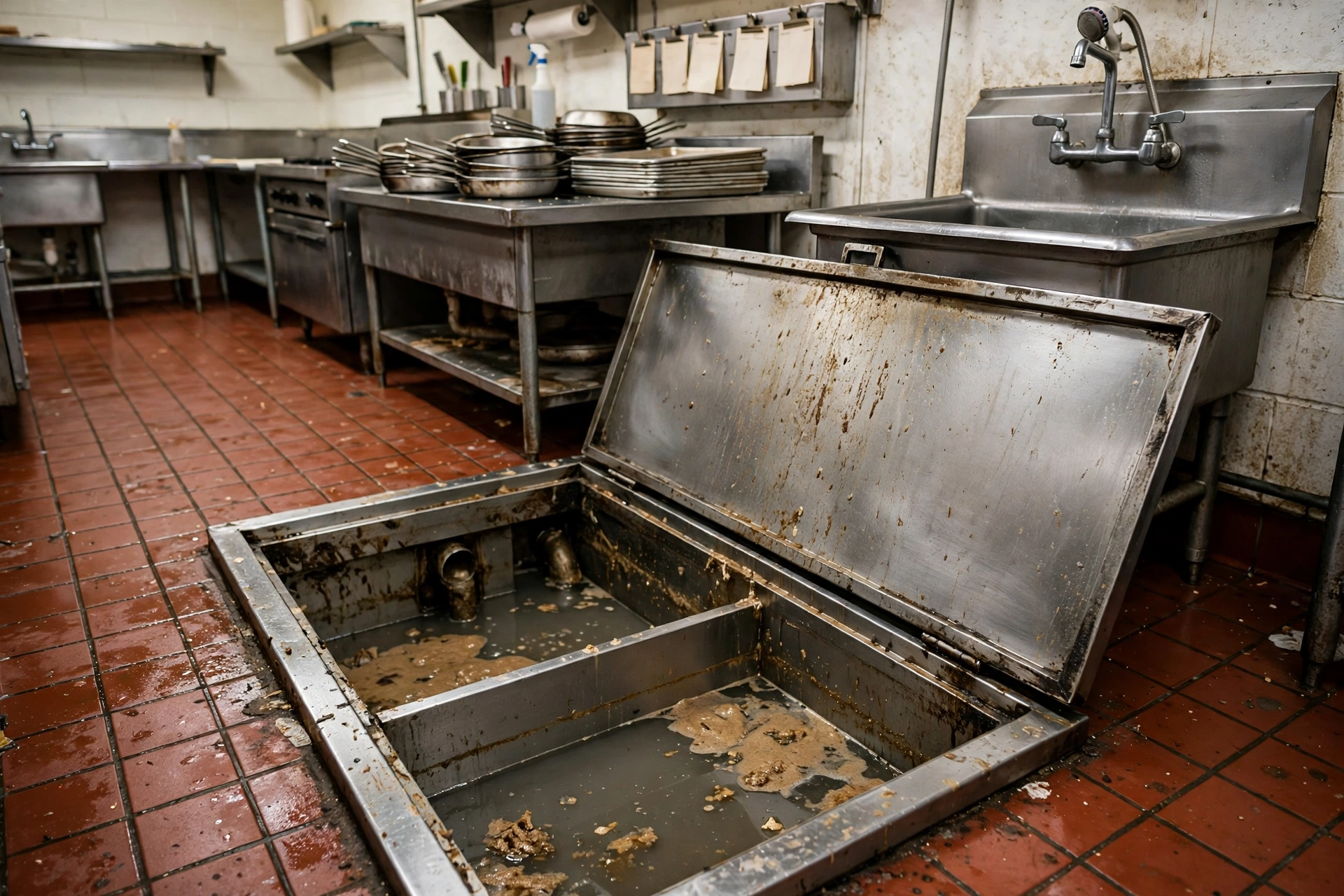
A lunch-led kitchen with a small indoor trap does not need a big truck and a big tank job. It needs the trap opened, emptied, scraped and checked on a rhythm that matches how much you cook. Most local restaurants clean small traps every one to four weeks. Where you land in that range depends on volume, and we find it by measuring, not guessing.
The measure is depth. When the contents reach 25 percent of the trap's design capacity, measured to the outlet invert, the trap is due. A fryer-heavy lunch counter can reach that line faster than a sandwich shop. Scheduled visits mean we arrive before that line, and we adjust the spacing after each reading.
How service runs for a Hahnville kitchen
Every visit follows the same three steps, whether it is your first or your fortieth.
1. We measure before we touch anything.
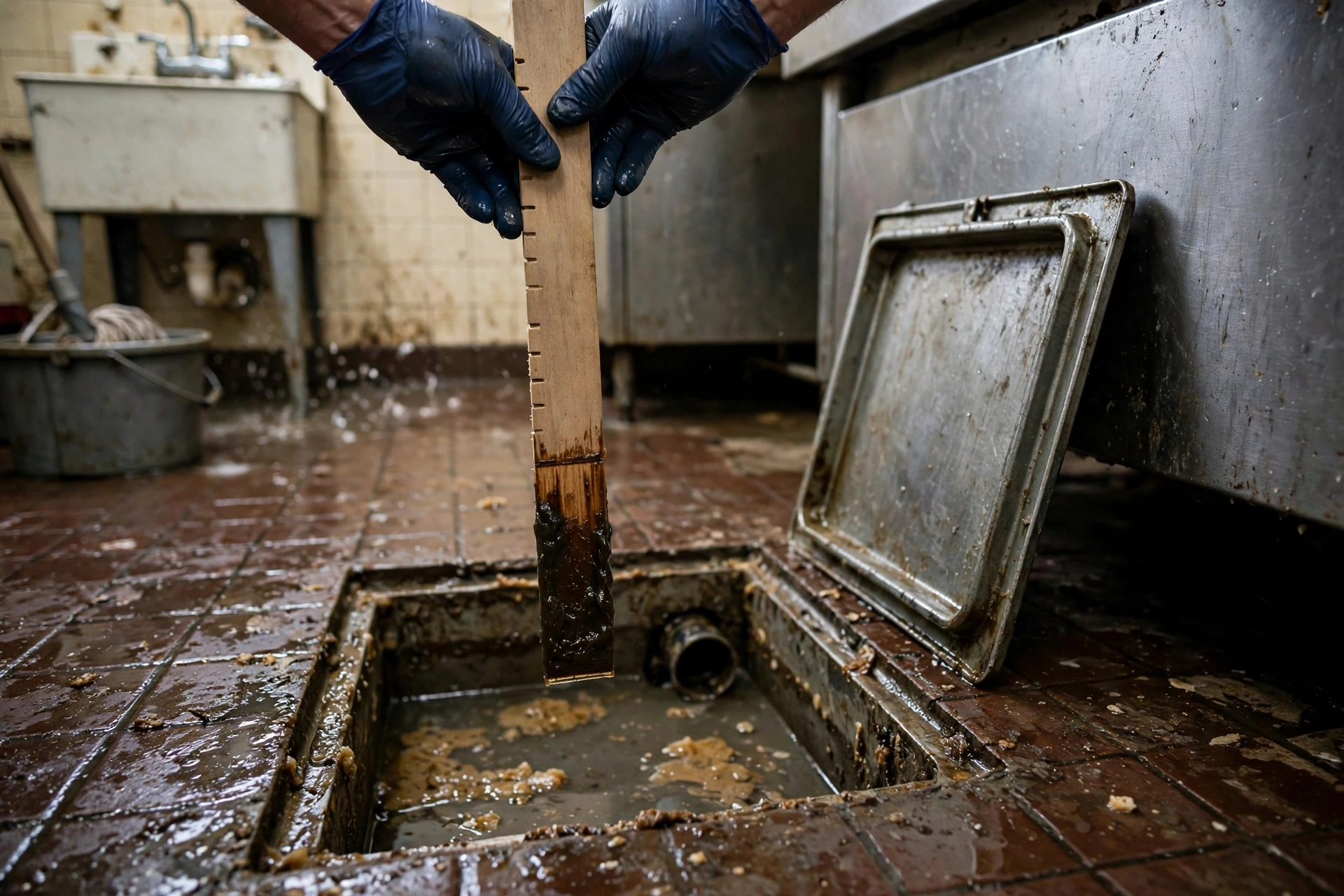
We open the trap and read the depth of the contents against the outlet invert. That reading tells us how close you were to the 25 percent line, and it tells us whether your visit spacing is right.
2. We pump and clean the trap.
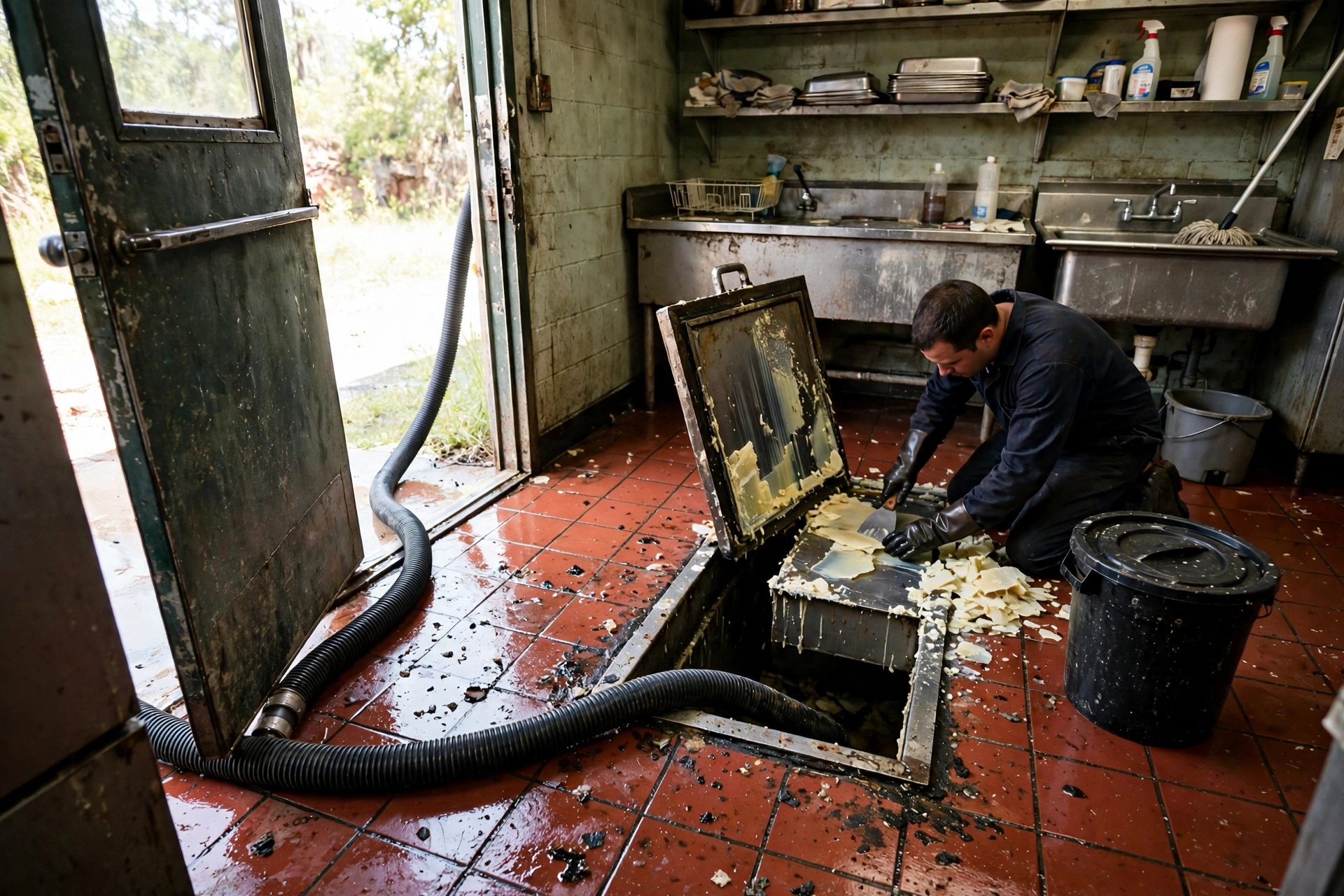
We remove the contents, scrape the walls, baffle and outlet, and check the lid, gasket and inlet and outlet fittings. A trap that is only skimmed leaves the solids that cause the next smell.
3. We write it up and leave you the paper.
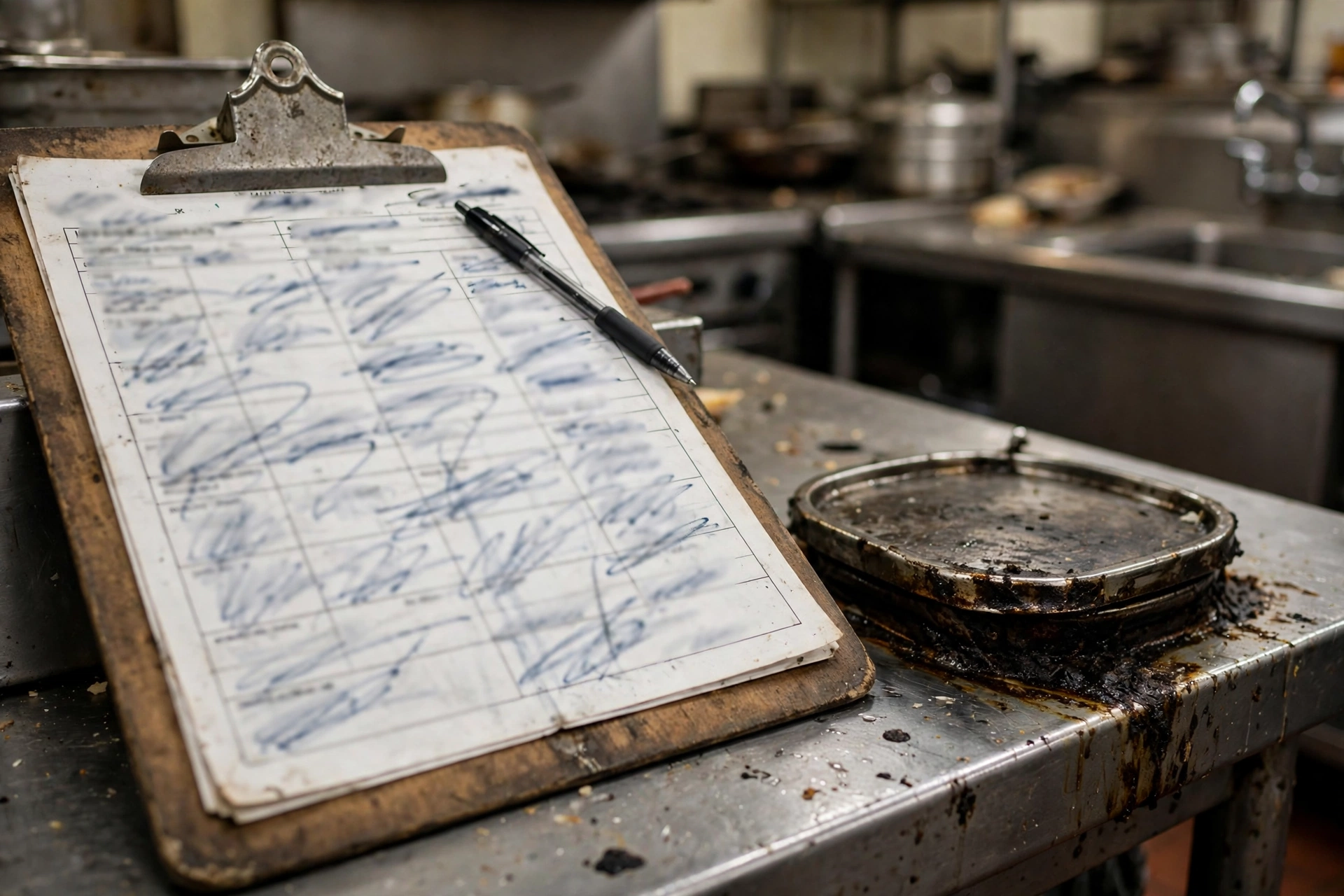
Grease trap waste moves under a Louisiana DEQ manifest that carries the hauler's name, address, phone, vehicle number and LDEQ hauler registration number, with the date and volume. You get your copy for the file. We note any defect we see, such as a cracked lid or a loose fitting, so you can fix it.
Featured job: a courthouse-side diner stops waiting for the backup
The kitchen
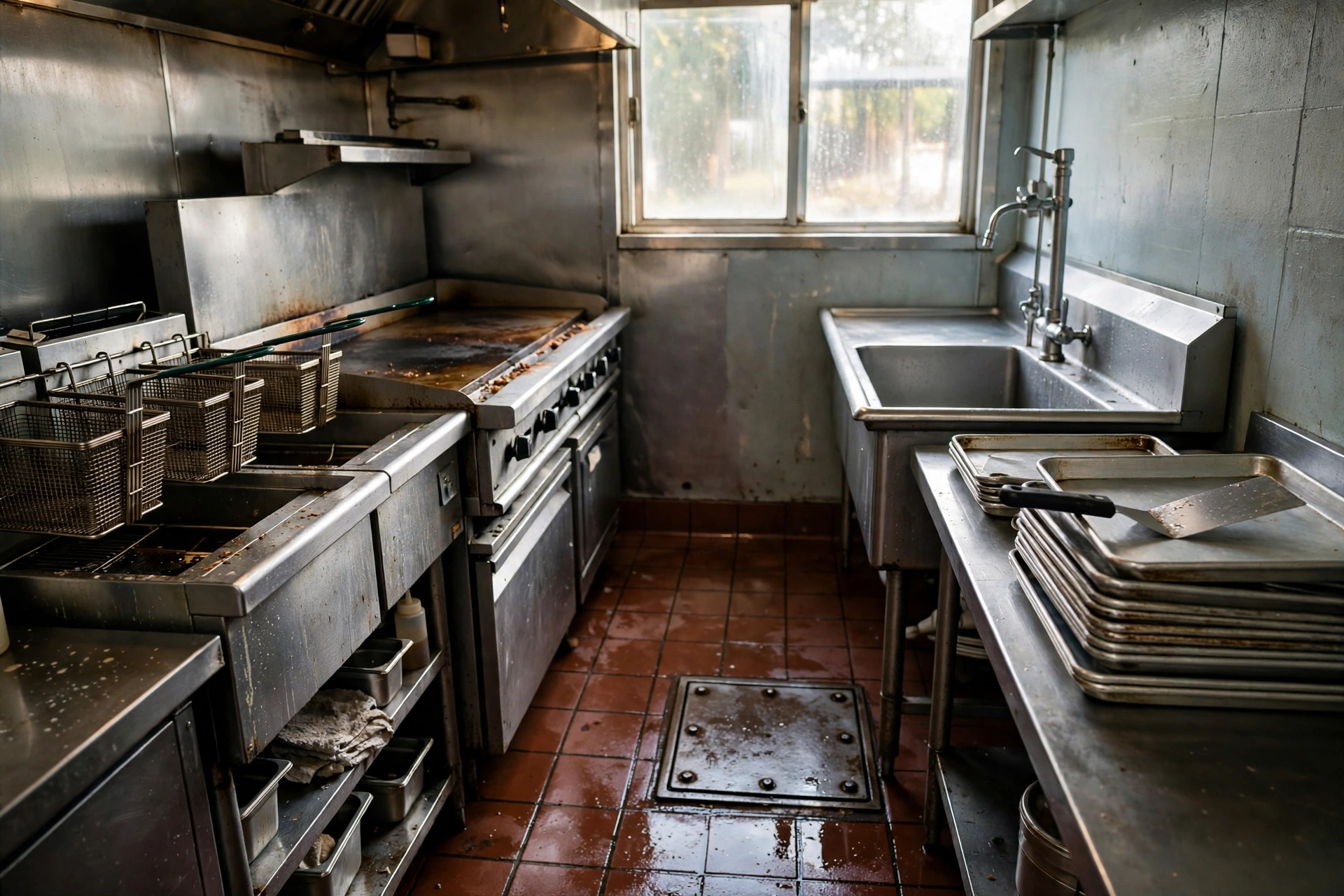
A weekday diner a few minutes from the courthouse ran a lunch rush that started the moment the courts broke and kept going as plant crews came through. Breakfast plates, fried plates, gravy, a flat-top that never cooled. The trap, an indoor unit in the up to 200 gallon band, had been cleaned when someone noticed a smell. The owner called us after a Tuesday when the three-compartment sink drained slowly through the whole rush.
The first visit
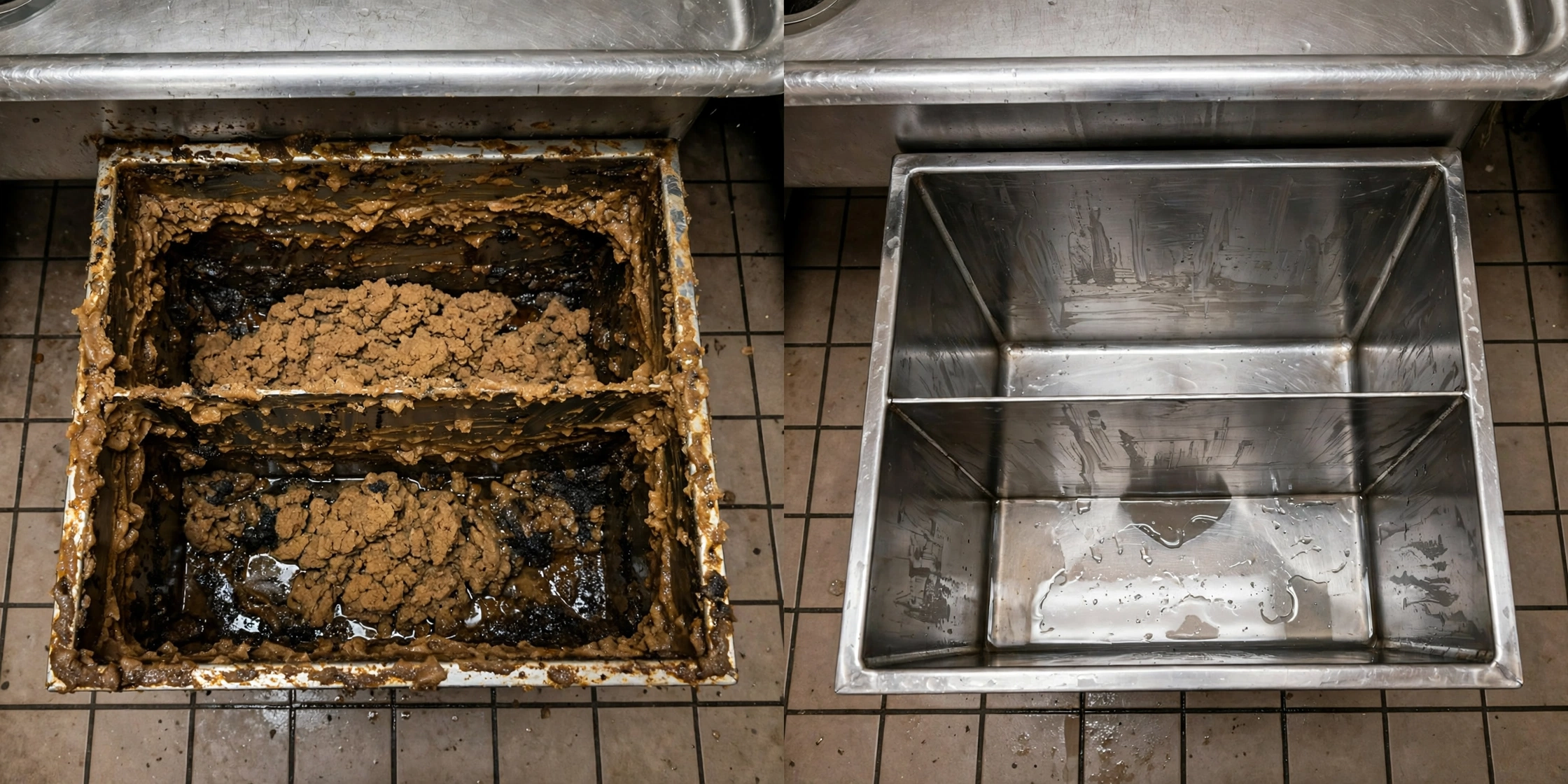
We opened the trap and measured. The contents stood past the 25 percent line, which is where a trap stops doing its job and starts passing grease downstream. We pumped it, scraped the baffle and outlet, and cleaned the lid seat. The visit was a scheduled-band visit for an indoor trap up to 200 gallons, which runs $125 to $180. The owner watched the stick reading before and after.
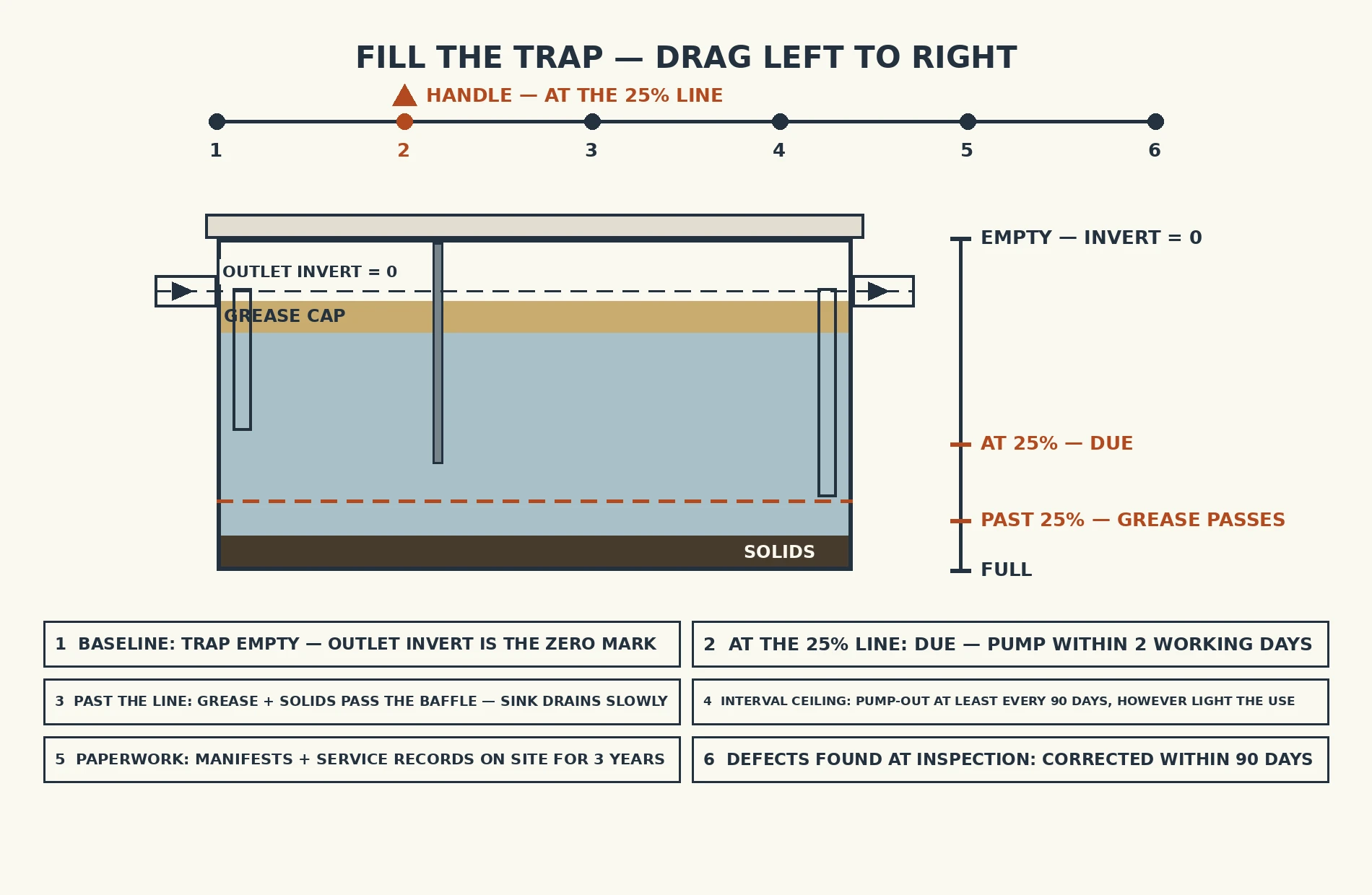
At the baseline: the trap is empty and the outlet invert is the zero mark for every reading.
At the 25 percent line: the trap is due. Contents at 25 percent of design capacity, measured to the outlet invert, mean pump within two working days.
Past the line: grease and solids begin to pass the baffle toward the sewer line, and the sink drains slowly.
At the ceiling of the interval: pump-out at least every 90 days, however light the use.
At the paperwork stop: manifests and service records stay on site for three years.
At the defect stop: defects found at inspection are corrected within 90 days.
The schedule
We did not set a number out of a book. We started the diner at the four-week end of the usual one to four week range for small traps, read the depth at the next visit, and tightened the spacing to match what the stick showed. The visit price stayed in the same band. What changed was that the Tuesday backup stopped.

What it costs
These are our prices. They are set by trap size and visit type.
| What we service | Our price per scheduled visit |
|---|---|
| Indoor trap up to 200 gallons | $125 to $180 on a scheduled visit. |
| Indoor trap 201 to 500 gallons | $175 to $475. |
| Interceptor 1,000 to 1,500 gallons | $225 to $450. |
| Interceptor 1,501 to 2,000 gallons | $600 to $1,200. |
| Interceptor 2,001 to 3,000 gallons | $800 to $2,500. |
| Emergency call-out, indoor trap | $190 to $240. |
| Line jetting | $100 when done with a service visit. Heavy jetting: $300 to $600. |
| Used cooking oil collection | no charge for clean oil, in containers from 30 to 320 gallons. |
Most Hahnville kitchens land in the first band. We tell you which band your trap is in before we come, and the price on the visit is inside it.
When to call
Call to set up a schedule if your trap has no regular visit, if you cannot remember its last cleaning, or if an inspector has asked for your records and you do not have them. Call the same day if a sink drains slowly after service, if you smell grease at the trap, or if the lid will not seat. A slow drain at the end of lunch is the late sign. The early sign is a depth reading near the 25 percent line.
Start with a call
Phone (504) 360-9231, Monday to Friday, 9:00 AM to 5:30 PM. We will place your trap in a price band, find the first open day for the drive to Hahnville and set the visit spacing from your first reading.
Questions
Do you service kitchens in Hahnville?
Yes. We drive out from New Orleans, about 30 to 35 minutes, and we schedule Hahnville visits so the trip is planned and not a rush.
What is scheduled trap service?
It is a standing visit on a rhythm that fits your kitchen. We measure the trap, pump it, scrape it, check the fittings and leave you the manifest. Most local restaurants clean small traps every one to four weeks, and we set yours from the depth readings.
How do you decide when my trap is due?
By depth. When the contents reach 25 percent of the trap's design capacity, measured to the outlet invert, it is due. Under the New Orleans rule, that means pumping within two working days.
How often does a trap have to be pumped at the very least?
The New Orleans rule is at least every 90 days. The state of Louisiana sets no pumping interval, and enforcement is local. A busy lunch kitchen will usually need far more frequent visits than the 90 day outer limit.
Do New Orleans rules apply to my Hahnville kitchen?
Hahnville is in St. Charles Parish, and the 90 day and 25 percent figures we quote come from the New Orleans program. We service to them because they are a sound working standard. What your parish requires of you is a question for the parish, and we can help you gather the records they ask for.
What does a visit cost for a small trap?
An indoor trap up to 200 gallons runs $125 to $180 on a scheduled visit. A trap of 201 to 500 gallons runs $175 to $475.
What if the trap backs up between visits?
Call us. An emergency visit on an indoor trap is $190 to $240.
What paperwork do I get?
A manifest for each pump-out. Under Louisiana DEQ rules it carries the hauler's name, address, phone, vehicle number and LDEQ hauler registration number, plus the date and volume. Keep manifests and service records on site for three years.
What does an inspector look for?
The service records, the trap's contents against the 25 percent line, the lid and fittings, and any defect from earlier inspections. Defects found at inspection are corrected within 90 days.
Can you also jet my drain line?
Yes. Line jetting is $100 when done with a service visit. Heavy jetting is $300 to $600.
What do I do with used cooking oil?
We collect clean used oil at no charge, in containers from 30 to 320 gallons.
Do you work with larger tanks in Hahnville?
Yes. Interceptors from 1,000 to 1,500 gallons run $225 to $450, 1,501 to 2,000 gallons run $600 to $1,200, and 2,001 to 3,000 gallons run $800 to $2,500.
When can I reach you?
Monday to Friday, 9:00 AM to 5:30 PM, at (504) 360-9231.
Send us your kitchen's details
Tell us your name and phone number, and we will call you back. Service, town and message are optional, but they help. The more details you give, the better we are able to help you.