Belle Chasse kitchens that run a big exterior tank need grease interceptor pumping done on a schedule and documented properly, and that is the work New Orleans Grease Trap does for restaurants along the Highway 23 corridor and the kitchens around it. The same visit covers grease trap cleaning at the fry line and the dish station, so one truck and one set of paperwork covers the whole kitchen.
Call (504) 360-9231 or send the form at the bottom of this page. Tell us what you have under the kitchen floor and what is buried out back, and we will tell you what the visit costs and when we can be there.
What Belle Chasse kitchens are like
The food trade here is built on the Highway 23 seafood corridor. Family seafood houses that fry, boil and steam all week sit next to smaller counters and cafes, and the naval air station sends steady lunch and dinner traffic into all of them. Fried shrimp, catfish, oysters and hush puppies put a heavy load of fat into a drain, and boiling and steaming add starch and shell debris on top of it.
Those kitchens are usually bigger than a French Quarter walk-in. They have room for a large exterior interceptor, often in the ground behind the building, and a smaller indoor trap that catches what the fryer and sinks send down first. Two devices means two jobs. The indoor trap fills fast and needs cleaning every few weeks. The tank outside takes longer to fill, but when it goes wrong it takes the whole kitchen down with it.
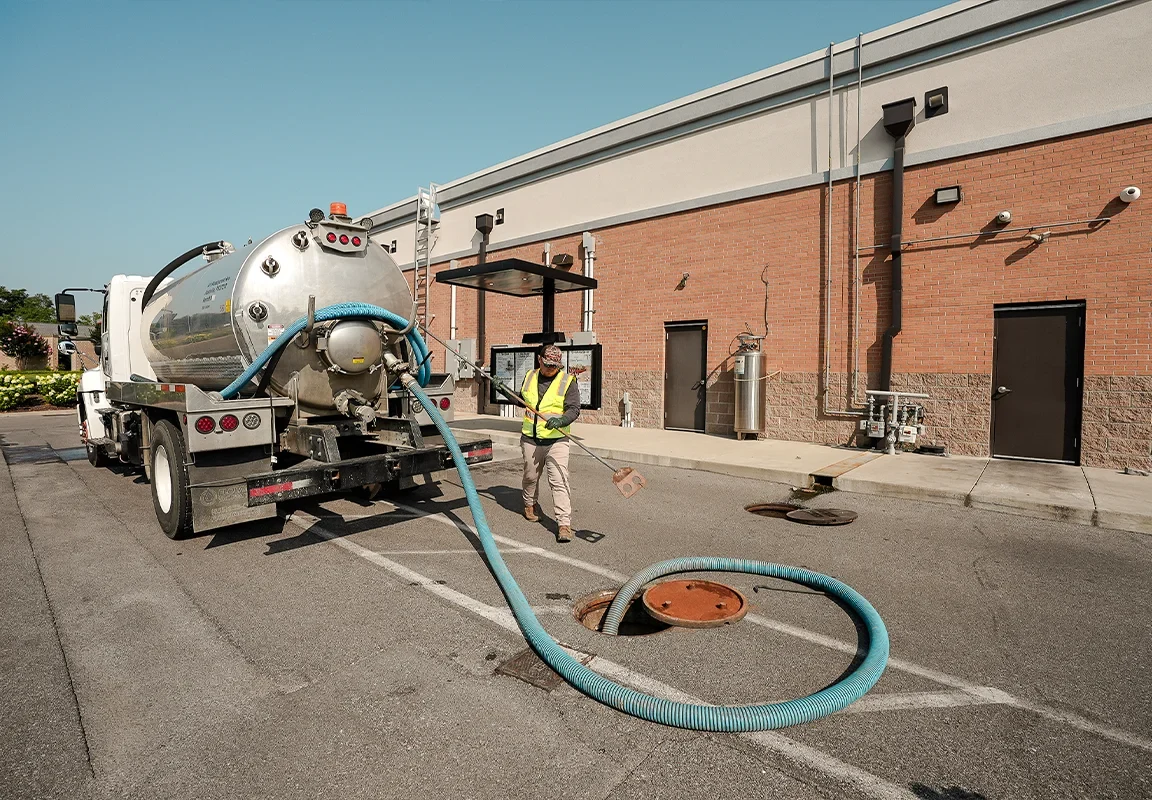
How the work goes for a Belle Chasse kitchen
On a first visit we find both devices and size them. We note the trap's gallon capacity, where the lid sits, and whether anything is parked or stacked over the access. Then we measure the contents against the design capacity, taken to the outlet invert. That measure decides everything. A trap or interceptor is due when the contents reach 25 percent of design capacity, and the city requires pumping within two working days of reaching it. Separately, the city requires a pump-out at least every 90 days no matter what the measure says.
Indoor traps are cleaned by hand and pump: we take out the lid and baffle, remove the fat, water and solids, scrape the walls and baffle, check the inlet and outlet, and put it back together. Most local restaurants clean small traps every one to four weeks. A busy fryer line sits at the short end of that range.
An interceptor is pumped with the truck. We remove the whole contents, clean the walls, check the inlet and outlet tees and baffles, and look for cracks or a loose cover. Grease trap waste leaves your site on an LDEQ manifest, which records our name, address, phone, vehicle number and LDEQ hauler registration number, plus the date and the volume taken. You get your copy to keep. The city wants manifests and service records on site for three years, and the manifest is the first thing an inspector asks for.
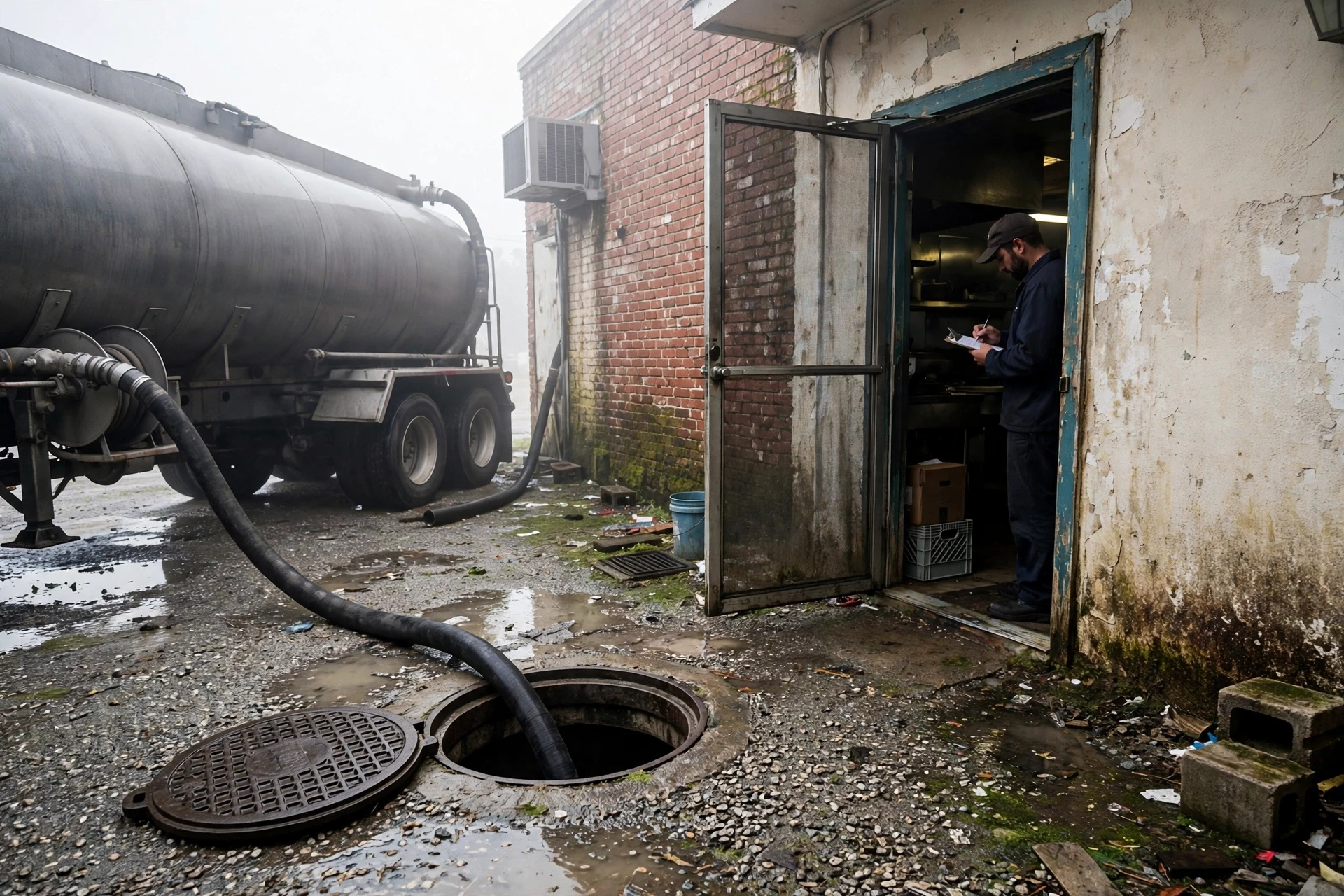
Defects found at inspection have to be corrected within 90 days. We list anything we see during service, such as a cracked baffle, a missing tee or a lid that will not seat, so you can fix it before it becomes an inspection finding.
Featured job: a Highway 23 seafood house and the tank behind it
This is the kind of job we are called to on the corridor. A family seafood house on Highway 23 had a kitchen that fried all day and boiled through the weekend. The owners had two devices: an indoor trap at the fry line and an interceptor in the ground behind the building, in the 1,000 to 1,500 gallon range. For a long time the interceptor was pumped when the floor drains began to slow, which meant it was pumped late every time.
The call
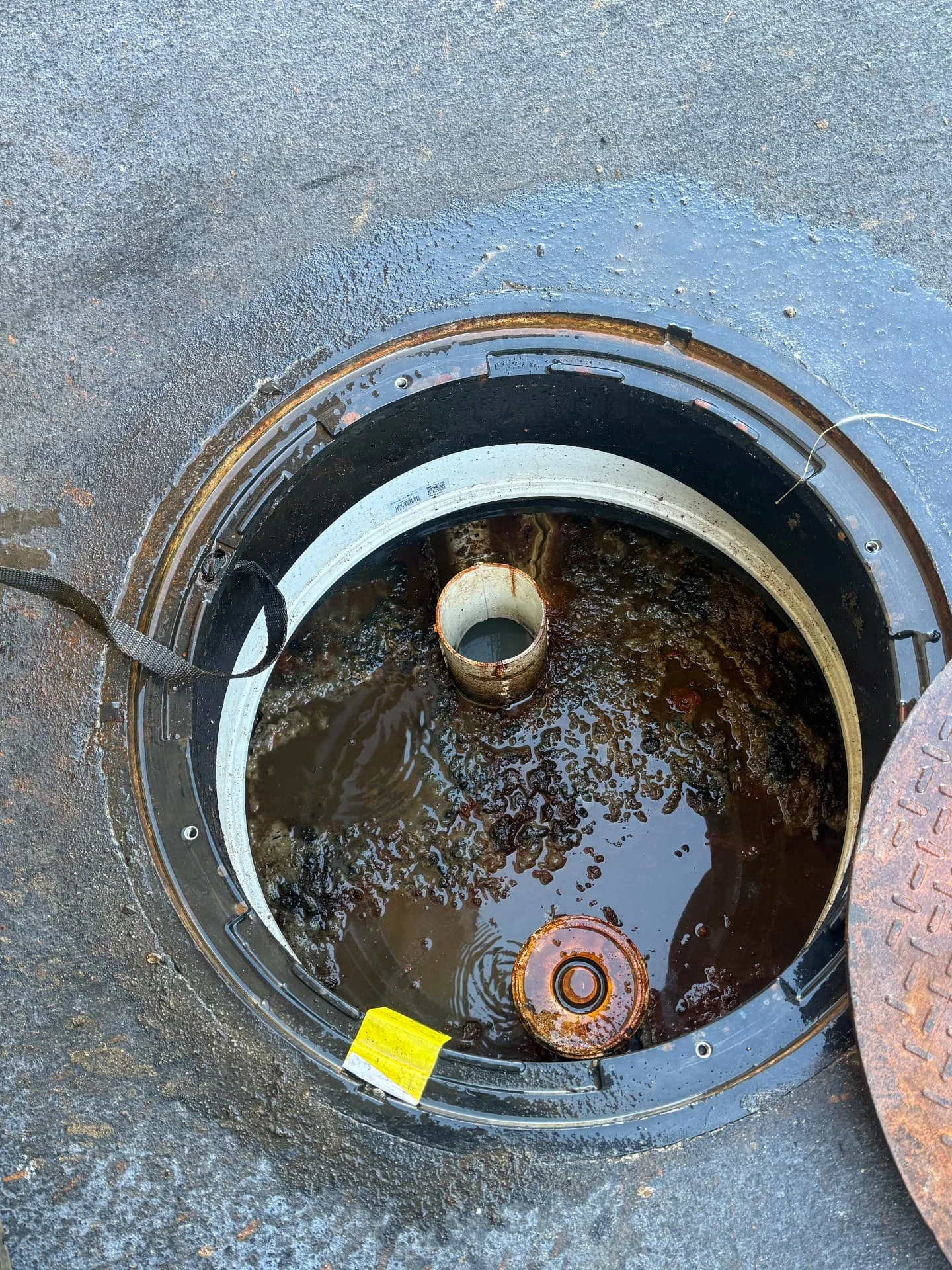
The kitchen phoned on a Monday after a weekend of backed-up floor drains in the dish area. The staff had been bailing the sink twice a shift. They wanted to know whether it was a clog or the tank. We came out the same week, lifted the lid and found the answer in the first look.
The measure
Here is how we read the tank. A sounding stick goes in until it touches the bottom, and we compare the depth of the fat and solids against the depth to the outlet invert. Past 25 percent of design capacity, the tank is due. This one was well beyond it.
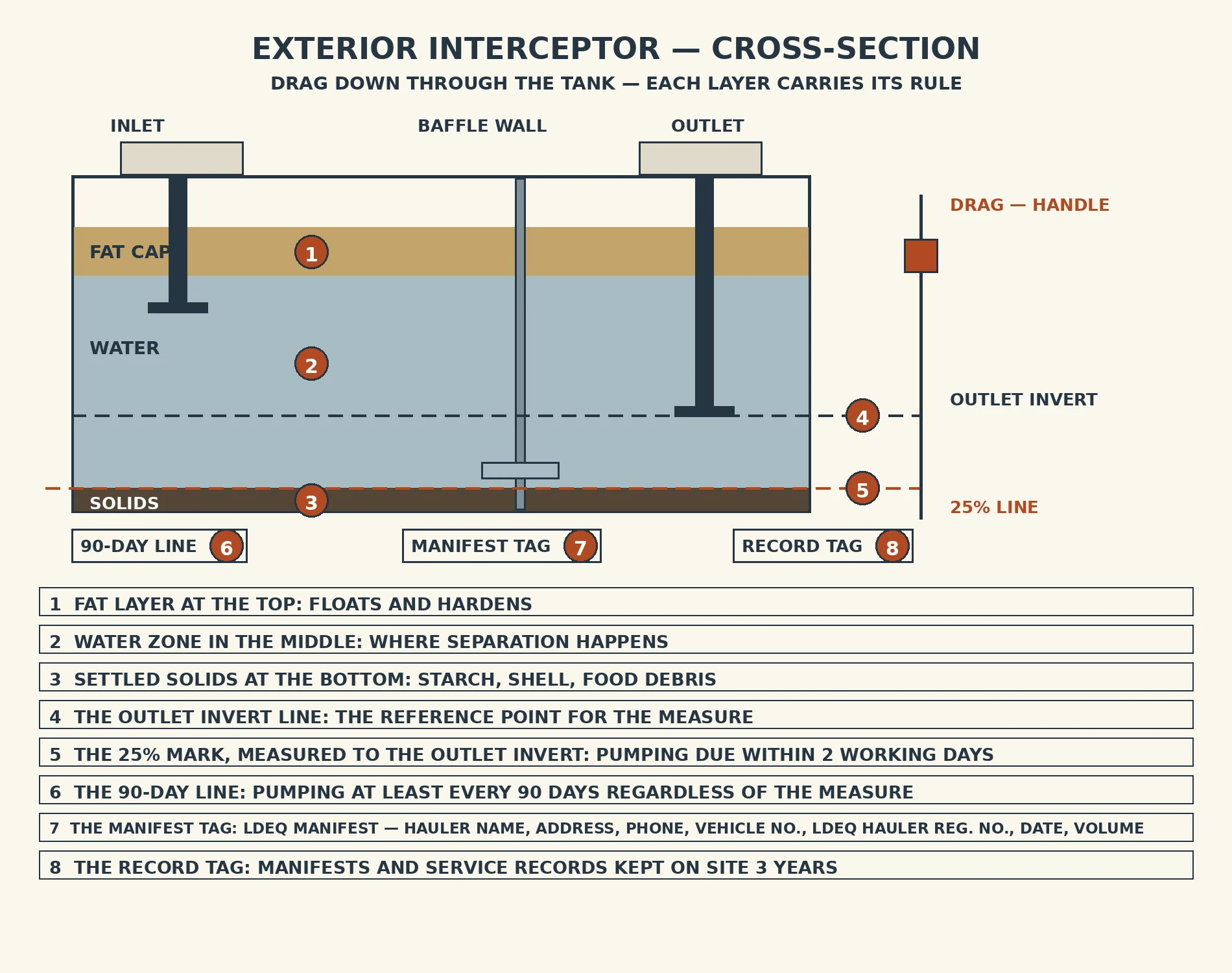
Fat layer at the top: floats and hardens
Water zone in the middle: where separation happens
Settled solids at the bottom: starch, shell, food debris
The outlet invert line: the reference point for the measure
The 25 percent mark, measured to the outlet invert: when contents reach it, pumping is due within two working days
The 90 day line: pumping is required at least this often regardless of the measure
The manifest tag: the LDEQ manifest records hauler name, address, phone, vehicle number, LDEQ hauler registration number, date and volume
The record tag: manifests and service records are kept on site three years.
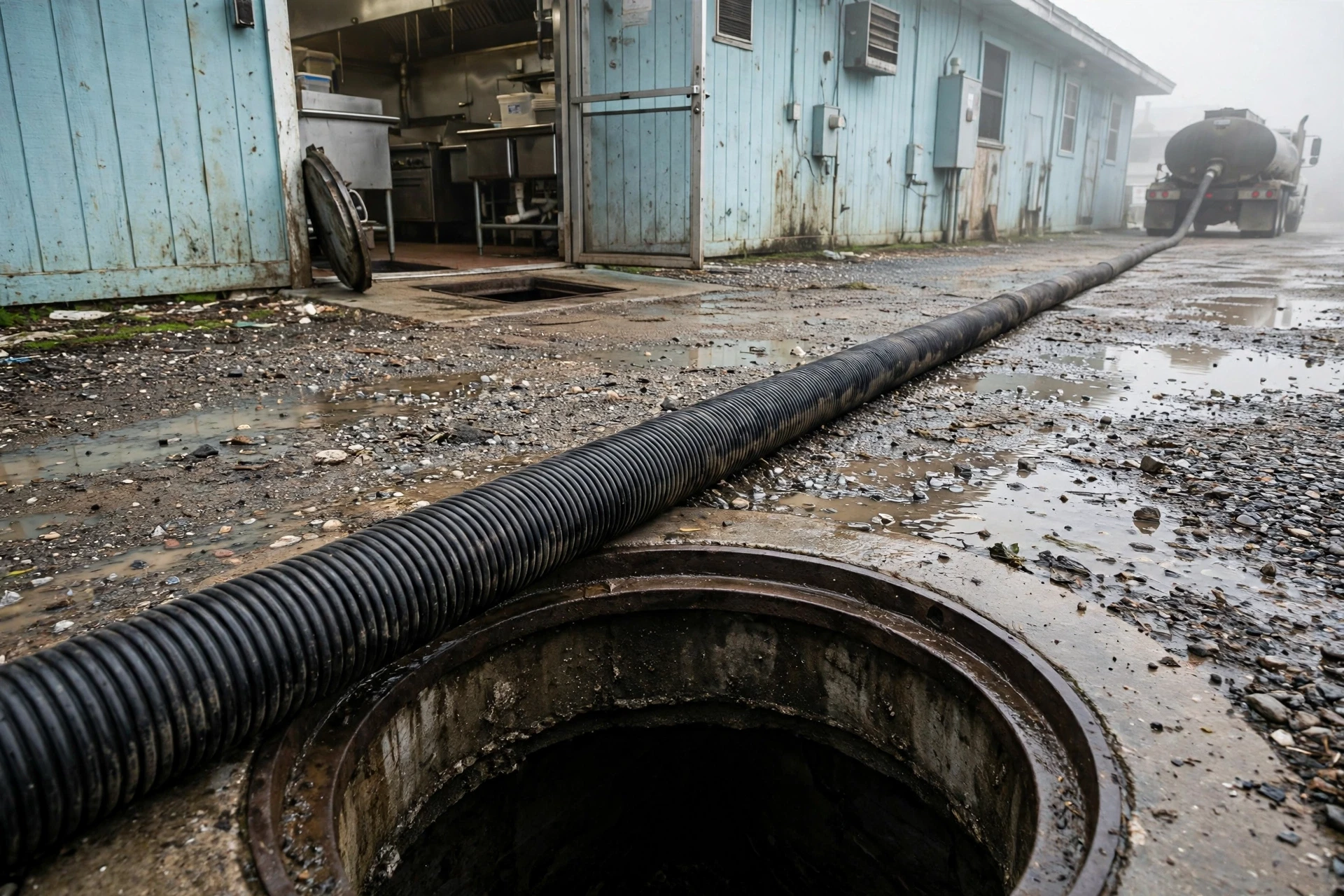
The pumping and the cleaning
We pumped the interceptor out in full, cleaned the walls and checked the baffles and tees, and cleaned the indoor trap at the same visit. Pumping a 1,000 to 1,500 gallon interceptor runs $225 to $450 on a scheduled visit, and the indoor trap, being under 200 gallons, runs $125 to $180. Doing both on one trip saves the owner a second visit. Because the drains were already slowing, we also offered line jetting at $100 with the service visit. Heavy jetting is $300 to $600 and is only needed when a line is badly packed.
The schedule afterward
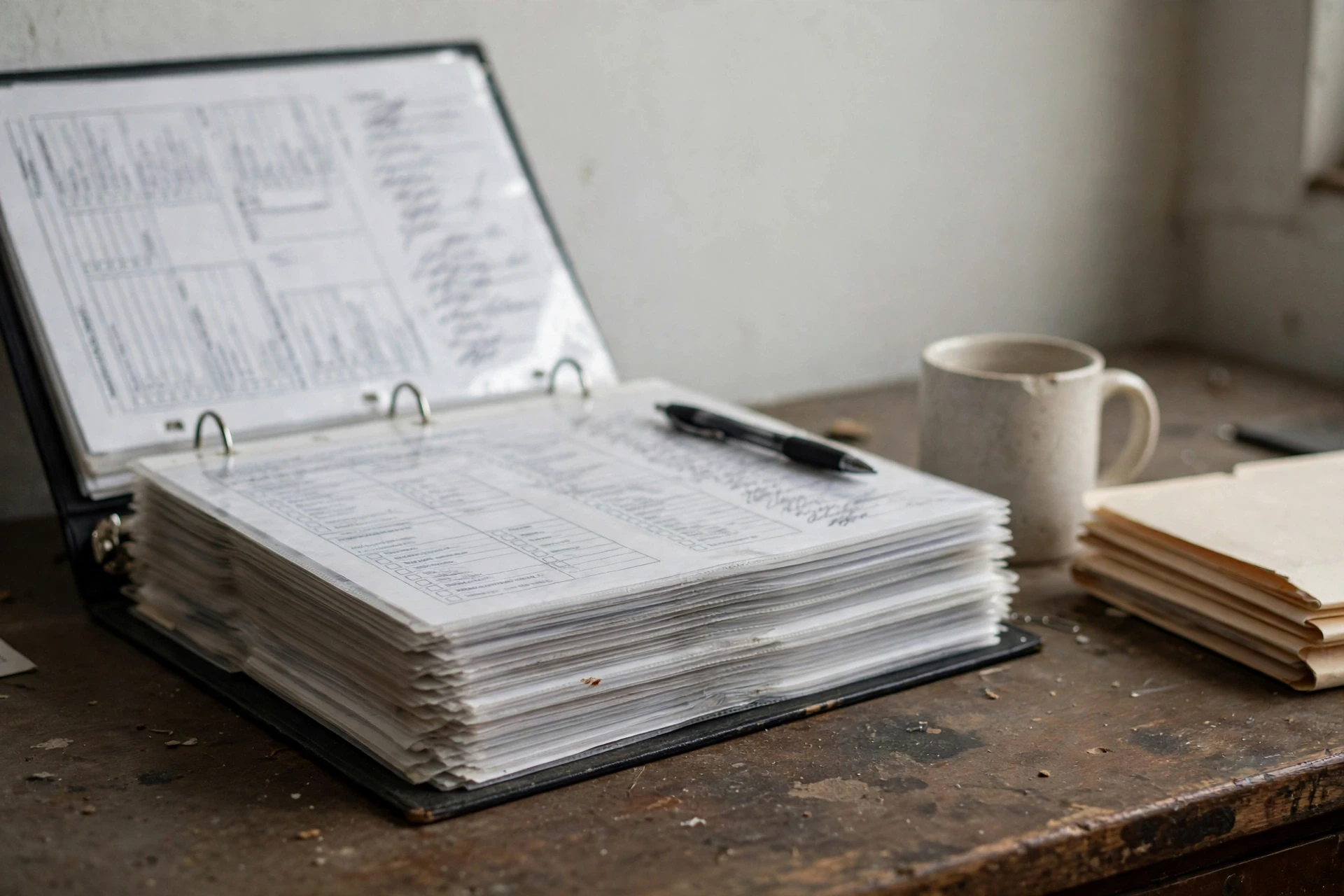
Once the tank had been emptied, we set the kitchen on a schedule: indoor trap cleaned every few weeks, interceptor checked against the 25 percent measure at each visit and pumped at least every 90 days. The floor drains stopped backing up. The kitchen now has a manifest for every pump-out in a folder by the office door, ready for the inspector.
What it costs in Belle Chasse
These are our prices. The first column is the size of the device and the second is what a visit costs.
| What we service | Our price per scheduled visit |
|---|---|
| Indoor trap up to 200 gallons | $125 to $180 |
| Indoor trap 201 to 500 gallons | $175 to $475 |
| Interceptor 1,000 to 1,500 gallons | $225 to $450 |
| Interceptor 1,501 to 2,000 gallons | $600 to $1,200 |
| Interceptor 2,001 to 3,000 gallons | $800 to $2,500 |
| Line jetting with a service visit | $100 |
| Heavy jetting | $300 to $600 |
| Emergency indoor trap | $190 to $240 |
| Emergency interceptor, 1,000 to 1,500 gallons | $400 to $900 |
| Used cooking oil collection | no charge for clean oil, in containers from 30 to 320 gallons |
Where a price falls in a range depends on how full the device is, how easy the access is and how much has to come out. A fryer-heavy kitchen with a late pump-out sits toward the top. A kitchen kept on schedule sits toward the bottom, which is the best argument for staying on one.
Sound like your kitchen? Call us
If you are running a seafood house, a cafe or a base-side lunch counter in Belle Chasse and are not sure whether your trap or tank is due, call (504) 360-9231. We are on the phone Monday to Friday, 9:00 AM to 5:30 PM.
When to call
The 25 percent measure has been reached. The city requires pumping within two working days.
It has been 90 days since the last pump-out.
Floor drains are slow or backing up, or the kitchen smells of rancid fat.
An inspection notice has arrived or one is coming and you cannot find your manifests.
A lid is cracked, a baffle is missing or a tee has failed. Defects found at inspection are to be corrected within 90 days.
You are changing the menu toward more frying or opening more days and want the interval reset.
If the kitchen is backing up now, ask for the emergency call-out. An indoor trap is $190 to $240 and an interceptor from 1,000 to 1,500 gallons is $400 to $900.
Used cooking oil
Fryer oil from a seafood kitchen has value, and we collect clean used cooking oil at no charge in containers from 30 to 320 gallons. We can pick it up on the same visit as your trap cleaning, so there is no extra trip.
Ready to book
Send the form, or call (504) 360-9231, and we will set a visit for your kitchen. Name and phone are required. Service, town and message are optional. The more details you give, the better we are able to help you.
[FORM: Name (required) · Phone (required) · Service (optional) · Town (optional) · Message (optional) · Consent checkbox (required)]
Questions
How far is Belle Chasse from your base, and do you travel there?
Yes. Belle Chasse is on our regular route, usually 20 to 30 minutes from our base in New Orleans, and we service restaurants and commercial kitchens there on a scheduled basis and for emergencies.
How often does a Belle Chasse restaurant need its grease interceptor pumped?
At least every 90 days. The city also requires pumping within two working days of the contents reaching 25 percent of design capacity, measured to the outlet invert. A fryer-heavy seafood kitchen often reaches that mark well before 90 days.
What is the 25 percent rule?
When the fat and solids in a trap or interceptor reach 25 percent of its design capacity, it is due for pumping. We measure to the outlet invert, which is the lowest point of the outlet pipe. Once it is reached, the city requires the pump-out within two working days.
How often should the indoor trap be cleaned?
Most local restaurants clean small traps every one to four weeks. The 25 percent measure governs when a trap is due, so a kitchen that fries all day will be on the short interval.
What does grease interceptor pumping cost?
For an interceptor of 1,000 to 1,500 gallons, our price is $225 to $450. For 1,501 to 2,000 gallons it is $600 to $1,200, and for 2,001 to 3,000 gallons it is $800 to $2,500. Where you fall in the range depends on how full it is and how easy the access is.
What does an indoor trap cleaning cost?
A trap up to 200 gallons is $125 to $180 on a scheduled visit. A trap of 201 to 500 gallons is $175 to $475.
What does an emergency call-out cost?
An emergency indoor trap is $190 to $240. An emergency interceptor of 1,000 to 1,500 gallons is $400 to $900.
Can you clear a slow line while you are there?
Yes. Line jetting is $100 when done with a service visit. Heavy jetting for a badly packed line is $300 to $600.
What paperwork do I get, and how long must I keep it?
You get a copy of the LDEQ manifest for every pump-out. It shows our name, address, phone, vehicle number and LDEQ hauler registration number, plus the date and the volume. The city requires manifests and service records to be kept on site for three years.
What does an inspector check?
That the trap or interceptor is permitted through the SWBNO FOG Program, that it has been pumped at least every 90 days, that contents are below 25 percent of capacity, that your manifests and records are on site, and that the equipment is in working order. Defects found are to be corrected within 90 days.
Do you take used cooking oil?
Yes. We collect clean used cooking oil at no charge, in containers from 30 to 320 gallons.
What are your hours?
Monday to Friday, 9:00 AM to 5:30 PM. The number is (504) 360-9231.
Do you service the kitchens that serve the naval air station trade?
We service any restaurant or commercial kitchen in Belle Chasse, whatever its customers. What matters to us is the size of the trap or interceptor and how hard the kitchen fries.